Power to cost 50% less for 82.4% of Delhiites
CAG to audit power discoms' books if lieutenant governor orders
BS Reporters New Delhi In a move that will benefit about 2.8 million people, Delhi’s three power distribution companies, controlled by Tata Power and Reliance Infrastructure (R-Infra), will halve retail charges for up to 400 kWh (units) of electricity from Wednesday. Also, if Lieutenant Governor Najeeb Jung recommends it in writing, these companies will face a statutory audit by the Comptroller and Auditor General (CAG) of India.
“We will provide 50 per cent subsidy to all Delhi households consuming up to 400 units of electricity every month. Of the 3.4 million consumers, 2.8 million would be benefited,” Chief Minister Arvind Kejriwal said after a meeting of the state Cabinet on Tuesday.
The cut in power charges have come a day after Kejriwal announced each household will get about 670 litres of free water every day.
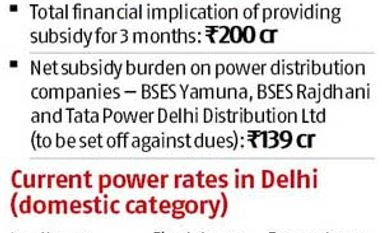
Addressing the media on Tuesday, he said the total impact of the cut in power rates will be Rs 200 crore for three months. Of this, Rs 139 crore would be borne by the power companies against the amount they owe the state government. At present, the state government gives Rs 1.20 as subsidy on each unit of power consumed in the lowest load category (up to 200 units).
Earlier in the day, Kejriwal had met Comptroller and Auditor General Shashi Kant Sharma, seeking an audit of the finances of BSES Yamuna, BSES Rajdhani and TPDDL. The national auditor agreed but clarified the scrutiny of discoms’ books would require a request from the lieutenant governor.
Kejriwal’s Aam Aadmi Party (AAP), which came to power in the capital earlier this month, had promised, among other things, a 50 per cent reduction in power rates. According to AAP, auditing holds the key to exposing the hidden financial surpluses with the three companies and clearing the grounds for a tariff reduction.
The chief minister said the government could order an audit of the companies, if required, but added the three companies would be given a day’s time to respond on the issue of a government audit of their books.
“They are being given time till tomorrow morning. By then, they will have to give their representations. The Cabinet will meet in the evening,” he told reporters before leaving for the CAG office.
The discoms refused to comment on the issue. Delhi Electricity Regulatory Commission (DERC) Chairman P D Sudhakar said the subsidy provision was the government’s prerogative.
Not an easy task A CAG audit might not be an easy task. The CAG Act of 1971 lays down that the duties and powers of the national auditor are with respect to audit of accounts of Union and state-owned government companies or corporations.
But discoms are not government companies as defined under the Companies Act of 1956.
A senior CAG official said private companies, under the law, were given a chance to explain why an audit of their books should not be conducted. CAG was well within its authority to conduct an audit of a private company if the matter was referred to it by the government.
“In the past, CAG has conducted the audit of private sector companies like Delhi International Airport Ltd (DIAL) and Reliance Industries Ltd (RIL),” he added.
DERC had observed in a May 2009 order that there was no provision for a CAG audit of private discoms. The Electricity Act of 2003 empowers DERC to “investigate certain matters and employment of any auditor or any other person for assisting it in such investigation”.
Delhi’s power distribution has been in private hands since July 2002. R-Infra holds 51 per cent stake each in BSES Rajdhani and BSES Yamuna, which cater to 75 per cent of the population. Tata Power holds a 51 per cent stake in TPDDL, which caters to the rest. The Delhi government holds the remaining 49 per cent in each of these companies, through Delhi Power Company Ltd.

 "Power to cost 50% less for 82.4% of Delhiites")


 Connect with us on WhatsApp