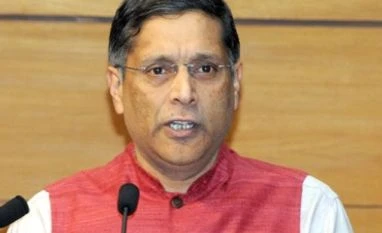
The Lecture Hall Complex at the Indian Institute of Technology (IIT), Delhi, is looking unusually busy these days, with hundreds of students and faculty members rushing in early to find good seats. The guest speaker is not a celebrated scientist or an engineer, but an economist. Arvind Subramanian, chief economic advisor to the government and former economist at the International Monetary Fund (IMF), has taken time off from his regular schedule to hold classes for a week on applied economics at IIT Delhi.
This is the first time after taking over as CEA in 2014 that Subramanian has donned a professor’s hat. His classes are part of the ‘Summer School for Economics Teachers’, a seven-day programme organised by the ministries of finance and human resource development to popularise open online courses.
The excitement among participants, including lecturers from IIT and other varsities (such as Delhi University and Jawaharlal Nehru University), was evident. Business Standard found on Monday that students from Subramanian’s alma mater, St Stephen’s College, and also from Hindu College, Lady Shri Ram College and others had turned up in large numbers at the third floor lecture hall at 10 in the morning, and stayed on for the whole day.
If the history of Indian economics was like a starter on day one (Sunday), Subramanian took up some of the contemporary topics on Monday. But the two items that consumed most of his time were the goods and services tax (GST) and inflation. “What happens when an item is exempted under the GST and is used as an intermediary for another product?” asked an elderly economist. “As the GST is applicable on the added value of a product at every stage, how does a company that sources its raw materials captively get income tax credit,” a PhD scholar was eager to know.
“One of the key benefits that the GST would bring in is it would have self-policing properties. In order to get input tax credit, a dealer would have to ask his seller for invoice, forcing a paper trail. But if the GST exempts an intermediary item, the chain of paper trail would break. This is a big challenge,” his answer was prompt.
As the debate over the GST heated up, Subramanian’s explanations touched on varied aspects of the new indirect tax structure. “While the GST would reduce corruption and leakages, in principle, some people may still remain outside the tax net,” he said.
He also threw light on exempted goods. While nearly 80 items including products like curd, bread and sindoor are exempted under the GST, actual taxation on them is not nil as intermediary items to produce these goods would still attract tax.
“Net tax on consumers for exempted items would not be nil, although that’s how it appears”, he explained.
Then there were questions around the Reserve Bank of India and interest rates, a subject over which the CEA has been in news recently.
Replying to a question on the possibility of 0 per cent interest, he said, “I am still fantasising about having the repo rate at 5.5 to 6 per cent and you gentleman are hoping for a zero interest. That would be too much for even me to take.”

 "CEA Subramanian goes to classroom for a week: GST tops list of questions")












