The Union government had “broadly” agreed to the Reserve Bank of India’s (RBI’s) decision to tighten the prompt corrective action (PCA) a month before it was released last year, sources in the central bank said on Tuesday.
An under secretary-level official of the Department of Financial Services (DFS) had written a letter to a chief general manager-level official of the RBI on March 3, 2017, saying the government is in “broad agreement” to the proposed changes to the PCA framework.
The RBI had released the revised PCA framework on April 13, 2017, which became one of the main areas of contention between the government and the regulator recently.
“Proper consultations between the government and the RBI on the PCA happened beforehand,” sources familiar with the matter said.
The RBI had proposed revising the revised PCA framework to the Ministry of Finance in September 2016. “The DFS had asked for some clarification, which was replied to. The RBI had also indicated in April 2017 that it is going ahead with the revised PCA framework. It is not as if the government was not consulted,” the source said. The RBI's letter confirming the final draft of the revised PCA norms was sent to the then financial services secretary Anjuly Chib Duggal, sources said.
An email sent to an RBI spokesperson did not elicit any response.
Senior officials had said on Monday that the government was upset with the central bank for not consulting it before finalising norms for the PCA and classification of non-performing assets (NPAs) and said that the RBI did not discuss these at its board meetings either.
Finance Minister Arun Jaitley had last week emphasised on the need for holding detailed discussions for regulators to arrive at policy decisions.
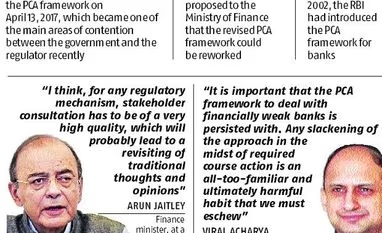
“I think, for any regulatory mechanism, stakeholder consultation has to be of a very high quality, which will probably lead to a revisiting of traditional thoughts and opinions,” he had said during an event.
The RBI took the decision to tighten the PCA framework last year, following recommendations of a sub-committee of the Financial Stability and Development Council (FSDC) in December 2014 which wanted an “early intervention mechanism” for banks.
The meeting, chaired by then RBI Governor Raghuram Rajan, was also attended by senior officials in the finance ministry.
The RBI had introduced the PCA framework for banks in December 2002 and it uses it as an early warning tool to maintain sound financial health of banks. The PCA is initiated once certain thresholds related to capital asset quality and NPAs are breached by a bank.
After the revised framework was notified in April last year, the RBI has put 11 of 21 PSBs, including Indian Overseas Bank, IDBI Bank and Bank of Maharasthra, under the PCA.
The government has demanded the RBI to align the PCA framework with global best practices, mainly in line with the Basel framework followed globally.
The government feels that the PCA framework is putting stress on banks in rural network by not allowing lenders to grow.
The minimum capital requirement of banks was an important issue of the PCA guidelines which the government asked the RBI to be relaxed. According to the RBI, the common equity tier 1 (CET-1) of banks must be at least 5.5 per cent of its risk-weighted assets.
However, the government feels that the RBI should prescribe banks to keep CET-1 at 4.5 per cent of their assets, which was stipulated by the Basel Committee on Banking Supervision, while releasing its report on Basel-III norms in December 2010.
The RBI has been relentless in relaxing the PCA framework and its Deputy Governor Viral Acharya had said during a public lecture recently that the imposition of PCA helped in “stabilising the banks at risk” and any relaxation to the framework may be avoided.
“It is important that the PCA framework to deal with financially weak banks is persisted with. Any slackening of the approach in the midst of required course action is an all too familiar and ultimately harmful habit that we must eschew,” Acharya said.

 "Locking horns: Centre might have agreed to RBI's revised PCA framework")












 Connect with us on WhatsApp