Beverage giant Coca-Cola wants the current average tax rate of around 34% on aerated drinks in the proposed goods and services tax (GST) to be retained, and the roll-out of the new tax regime deferred by two months to September 1.
The GST council recently approved a 15 per cent cap on cess on aerated drinks over the peak rate of 28 per cent. Coca-Cola has essentially called for around six per cent cess on it over the peak rate.
The multinational company argued that its products are neither a sin product not a luxury item, but even then it is okay with around 34 per cent tax. Coca-Cola’s vice president-taxation, R Sridhar, told Business Standard it will be fair to implement GST from September 1, instead of July 1, considering that the industry will be left with just about two-and-a-half months after the rules are finalised by mid-April.
“If rules are finalised by mid-April, time till June 31 is a very unfair preparation time. The industry is willing to catch up with the government, but two-and-a-half months is not enough,” he said. “If all states are ready with the law by May, then September 1 is a fair date,” he added.
The GST Council, the highest decision-making body for the new indirect tax regime, chaired by Finance Minister Arun Jaitley with state finance ministers as members, has decided to include aerated drinks under the highest tax slab of 28%, which will also attract an additional cess. These items are sin and luxury goods, which include luxury cars, tobacco and its products.
Sridhar said it was unfair to club aerated drinks with pan masala, tobacco and luxury cars, since it is “neither a sin product, nor a luxury item”. The Union government itself had accepted it was not a sin product by removing it from the Schedule VII of the Finance Act in the 2015-16 budget, he pointed out.
“They removed aerated drinks from the sin category, on which an incremental duty was charged on tariff. The government has already admitted that aerated drinks are not ‘sin.’ They cannot again categorise aerated beverages as ‘sin’,” he said. Sridhar added that a coke bottle costing Rs 15 also does not categorise as a luxury item.
In a meeting on Thursday, the Council approved a cess of up to 15 per centfor aerated drinks and luxury cars.
However, actual cess would be lower than the cap. Citing the example of luxury cars, Jaitley had said the current tax incidence of 40per cent will be maintained with a 12 per cent cess.
“The 12% example given by Jaitley was with respect to luxury cars. That does not mean that it will also be the case for aerated drinks. Our effective tax rate of Indian market is not 40%. It is between 32 per cent and 34 per cent. We are hoping that it will continue to remain the same under GST,” said Sridhar.
He argued that only six states are taxing it at a higher rate. Madhya Pradesh, Rajasthan, Karnataka, NCR and Kerala charge value added tax at 20%, and Maharashtra at 25per cent. The excise duty imposed by the Centre was hiked to 21% in 2016 from 18% earlier.
“These are just six states in India. That is not the geographical truth of the country. We sell throughout the country and cover more than 60% of the territory. Gujarat, which is the most industrial state, does not tax us more than the national average of 14.5-15%. Andhra Pradesh and Tamil Nadu are again big markets for us,” said Sridhar.
He said Goa, which was taxing it at 20%, lowered it to 15%. “If the government can quote statistics, so can we.”
Sridhar said the company has presented its case to the government through the Indian Beverage Association (IBA) and separately through various channels and forums.
The IBA represents leading players such as Coca-Cola India, PepsiCo India, Tetra Pak India, Dabur, Mondelez, Parle Agro, Hindustan Coca-Cola Beverages among others.
The Coca-Cola system in India invested $2 billion till 2011, since its re-entry into India. The company will be investing another $5 billion till 2020.

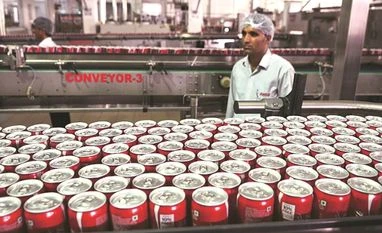 "Coca-Cola bats for 34% tax under GST")












 Connect with us on WhatsApp