Consolidation in petroleum sector: Why bigger is better for oil companies

Bigger oil PSUs will be in a better position to safeguard their interests against green energy
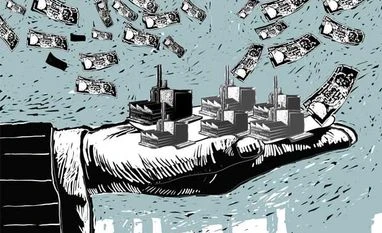
Oil PSUs
Jyoti Mukul New Delhi
Last Updated : Jul 05 2017 | 3:50 AM IST
Public-sector undertakings dominate in the petroleum sector. Whether it is in producing oil and gas or the downstream business of retailing petroleum products, they have the lion’s share in the industry. The government, however, aims to create even bigger PSUs through consolidation.

“It’s not going to be a merger of all oil public sector undertakings into one,” Petroleum Minister Dharmendra Pradhan said after the announcement for consolidation was made by Finance Minister Arun Jaitley in his Budget speech. “It’s an in-principle decision taken by the government to develop a few integrated state oil companies, which will have better risk management capacity and the clout to compete in international markets,” said Pradhan.  

Though this hinted at creation of more than one integrated company, it is widely expected that the biggest of them all, Oil and Natural Gas Corporation (ONGC), will be the first one to get off the block to become even bigger through some form of takeover of Hindustan Petroleum Corporation Ltd (HPCL), the second largest petroleum retailer in the country.

There are parallel proposals of GAIL India, the biggest natural gas company in the country, combining with Oil India Ltd, while HPCL itself is reportedly keen to take over Mangalore Refinery and Petrochemical, which is an ONGC subsidiary. Whatever be the combinations, integration could mean that the government as a promoter will have to take a call on what happens to its equity in the company that is sought to be merged or taken over.

ONGC Chairman and Managing Director DK Sarraf says the integration between upstream and downstream is a good idea from the point of view of both sides. “Integrated company can be more financially stable. Internationally, the value which an integrated company gets is much higher in terms of PE multiple or return to investors. If something like this happens, it will be good for the sector,” he says.

With low carbon usage as the motivator, the global push towards renewable energy could create uncertainty for standalone players.

Analysts, too, see the ONGC-HPCL deal as a positive for ONGC. According to a recent report by Emkay, the deal will allow ONGC to navigate periods of oil price downturns relatively smoothly, as refining margins typically expand during such periods.

The report, however, adds that significant operational synergies from the proposed merger are not expected. “Moreover, there could be hindrances in HPCL’s internal decision making if ONGC management insists on taking an interest in day-to-day activities.”

The report say the payback period for ONGC for such a deal could be little more than five years while the return on equity to ONGC’s shareholders will increase by over 150bps.

“If ONGC acquires a 51 per cent stake in HPCL, valuation of ONGC works out to Rs 258 a share, which implies an increase of 17 per cent from our current valuation estimate of Rs 220 a share after accounting for the debt taken to acquire the stake in HPCL,” says the Emkay report.

The purpose of creating a bigger entity through ONGC and HPCL, however, will be achieved only in a limited way. The Emkay report points out that a combined market cap of the two companies will be $37 billion, which is relatively small compared with global integrated oil giants like Shell or BP.

“This, however, will be a step in the right direction to create an entity with the right size and might that can better compete with global competitors,” it adds.

The nature of consolidation is not yet finalised but a takeover of government equity could trigger an open offer under the Security and Exchange Board of India regulations, unless an exemption is granted, to safeguard the interest of minority shareholders.

In such a scenario, ONGC will have to shell out upwards of Rs 40,000 crore for HPCL. Financing such a big acquisition will require ONGC to either go in for selling its crossholding in other oil PSUs or raise debt.

The other consolidation model is to go in for a merger which could create a combined entity. 
 
“The Union government as a promoter of both ONGC and HPCL can decide to merge the two companies. The board of combined entity can have a director representing the refining and marketing wing of the business,” says a senior official.

A yet another option is to create a holding company to which the government shares in the two companies can be transferred. Such an entity can then be listed, allowing the government to monetise the consolidation. In future, there will be room to bring more companies into the holding company’s fold.

Such a model will be much easier to follow. The holding company could smoothen the often conflicting efforts of the constituents and forge a united front whenever required for grabbing a business opportunity. Such a holding company could be listed at a much greater valuation even as the subsidiaries (ONGC, HPCL, etc) could remain listed, too.

It is not the first time that a proposal for consolidation is being discussed within the government. Mani Shankar Aiyar, petroleum minister in the United Progressive Alliance government, had set up a committee under V Krishnamurthy to examine the issue. The proposal was rejected by the panel in its report in 2005, Synergy in Energy.

The government this time has appointed Deloitte as its consultant to work out a feasible model and the report is expected soon. Once the ministries agree on a feasible model, the mandatory Cabinet approval and clearance from the respective boards of the companies will be required.

Any move will have to be justified on the grounds of its gains to the companies involved and the larger purpose it serves the economy. What the government needs to guard against are disruptive models that complicate decision-making.

One subscription. Two world-class reads.

Already subscribed? Log in

Subscribe to read the full story →
*Subscribe to Business Standard digital and get complimentary access to The New York Times

Smart Quarterly

₹900

3 Months

₹300/Month

SAVE 25%

Smart Essential

₹2,700

1 Year

₹225/Month

SAVE 46%
*Complimentary New York Times access for the 2nd year will be given after 12 months

Super Saver

₹3,900

2 Years

₹162/Month

Subscribe

Renews automatically, cancel anytime

Here’s what’s included in our digital subscription plans

Exclusive premium stories online

  • Over 30 premium stories daily, handpicked by our editors

Complimentary Access to The New York Times

  • News, Games, Cooking, Audio, Wirecutter & The Athletic

Business Standard Epaper

  • Digital replica of our daily newspaper — with options to read, save, and share

Curated Newsletters

  • Insights on markets, finance, politics, tech, and more delivered to your inbox

Market Analysis & Investment Insights

  • In-depth market analysis & insights with access to The Smart Investor

Archives

  • Repository of articles and publications dating back to 1997

Ad-free Reading

  • Uninterrupted reading experience with no advertisements

Seamless Access Across All Devices

  • Access Business Standard across devices — mobile, tablet, or PC, via web or app

Next Story



