Domino effect of auto crisis: Livelihoods, India's GDP growth may take hit

35 million jobs at stake with India's automobile sector in trouble, components business could be impacted as well
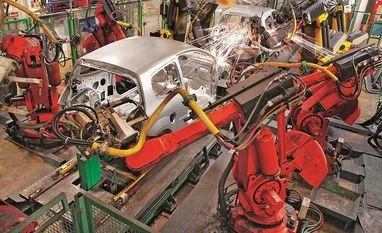
Domino effect of auto crisis: Livelihoods, India’s GDP growth may take hit
Sai Manish New Delhi
4 min read Last Updated : May 22 2019 | 2:14 PM IST
The dismal April automobile sales figures released by the Society of Indian Automobile Manufacturers (SIAM) portends doom for the entire ecosystem of vehicle production in India and could well be a yoke around the neck of the new government in India. SIAM says the production of vehicles in India declined 10.69 per cent in the first month of 2019-20 to 2.4 million vehicles, year-on-year. There has been a decline across all segments – car sales have dipped 20 per cent, two-wheelers, which comprise the bulk of vehicle sales in India, fell 16 per cent and commercial vehicle sales were down six per cent.

A closer look at recent figures shows that the automobile industry has been in the doldrums in recent months. Vehicle production has literally stagnated at around 2.4 million vehicles since November 2018, with output hitting a low of 2 million vehicles in December 2018. A longer-term view would give a better picture. In 2018-19, passenger vehicle production grew below one per cent over the previous year. Under the Modi government, passenger vehicle production in India had been growing at almost seven per cent annually on an average. Sales of such vehicles, according to SIAM, grew three per cent in 2018-19 – the lowest since the Modi government came to power. Exports of cars and utility vehicles too have been declining for the past two years. Two-wheeler production, which had plummeted to its lowest levels in years in 2014-15 but grew impressively during the following years, has again tumbled six per cent. Annual two-wheeler sales have grown at the lowest level since 2014-15. The same is the case with all vehicles produced in India.

GDP growth at risk

The impact of this stagnation could be deleterious for the Indian economy for various reasons. Firstly, according to the Indian government, the automobile sector accounts for almost half of India’s manufacturing Gross Domestic Product (GDP), a quarter of its industrial GDP and almost seven per cent of the country’s GDP. Slacking of vehicle sales could have a sobering impact on India’s economic growth for 2018-19 which the Central Statistics Office (CSO) will reveal a week after the election results are announced on May 23. The Indian economy grew at 6.6 per cent in the third quarter of 2018-19, its slowest in the last five quarters. In April, the International Monetary Fund (IMF) had projected the Indian economy to grow by 7.3 per cent in 2019-20 – down from 7.5 per cent it had projected earlier.

Impact on auto components

Secondly, if the automobile industry takes a hit, there will be a domino effect on auto component manufacturers and flat steel manufacturers. The auto components industry contributes 2.3 per cent of India’s GDP and has been growing at seven per cent according to government figures. A large number of auto component makers are small players that make more companies and people vulnerable to the slowdown. Upkaar Singh Ahuja, chairman, Swan Automotive, a Ludhiana-based manufacturer of sheet metal parts for passenger vehicles and two-wheelers, told Business Standard, “The situation is akin to what happened after the note ban of November 2016.” To rein in the cost, Swan has been curtailing operations to four or five days a week, depending on the schedule of its customers. Owing to the uncertainty ahead, it has also postponed the plan to set up a new facility. Swan gets a big share of its revenues from Honda Motorcycle and Scooter India, and Maruti Suzuki India.

Job scene to worsen 

Thirdly, if people don’t buy enough cars and two-wheelers, India could be staring at an employment crisis in the sector. Government figures show that the automobile sector provides direct and indirect employment to 32 million people. The auto components and after-market segment provide employment to another three million people directly and indirectly. Any downturn in the industry could potentially jeopardise India’s uncertain employment scenario even further. A proprietor at another auto component maker in the Pune-Chinchwad belt, which has Tata Motors as its key customer, told Business Standard that he had to let go of close to two dozen contract workers over the past six months following a slowdown in truck sales after implementation of the axle norms in November. Ahuja and the other supplier reflect the predicament facing small suppliers as India’s auto industry grapples with the one of the worst slowdowns in many years. And that may be bad news for the new government that comes to power in India.

One subscription. Two world-class reads.

Already subscribed? Log in

Subscribe to read the full story →
*Subscribe to Business Standard digital and get complimentary access to The New York Times

Smart Quarterly

₹900

3 Months

₹300/Month

SAVE 25%

Smart Essential

₹2,700

1 Year

₹225/Month

SAVE 46%
*Complimentary New York Times access for the 2nd year will be given after 12 months

Super Saver

₹3,900

2 Years

₹162/Month

Subscribe

Renews automatically, cancel anytime

Here’s what’s included in our digital subscription plans

Exclusive premium stories online

  • Over 30 premium stories daily, handpicked by our editors

Complimentary Access to The New York Times

  • News, Games, Cooking, Audio, Wirecutter & The Athletic

Business Standard Epaper

  • Digital replica of our daily newspaper — with options to read, save, and share

Curated Newsletters

  • Insights on markets, finance, politics, tech, and more delivered to your inbox

Market Analysis & Investment Insights

  • In-depth market analysis & insights with access to The Smart Investor

Archives

  • Repository of articles and publications dating back to 1997

Ad-free Reading

  • Uninterrupted reading experience with no advertisements

Seamless Access Across All Devices

  • Access Business Standard across devices — mobile, tablet, or PC, via web or app

Next Story



