Exporters ask government to provide barter deal with agri-deficit nations

Negotiations likely with Japan, EU, US, South Korea to boost India's agri exports and balance out their electronics exports into India
India, export, import, EU, European Union, basmati rice, Indian agriculture, Crop Care Federation of India, Indian export, Indian imports
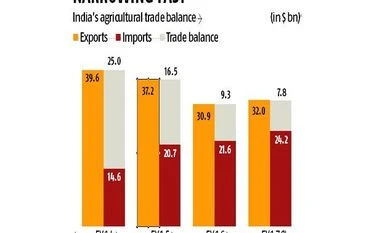
India’s agricultural trade balance (in $ bn)
Dilip Kumar Jha Mumbai
Last Updated : Jan 12 2018 | 3:54 AM IST
Exporters have urged the government to start a barter deal with agriculture-deficit countries to boost India’s exports of agricultural and allied products on a sustained basis.

Faced with restrictions imposed by many countries, India’s exports of agricultural products have declined by 19 per cent in the past four years to $32 billion in 2016-17 from $39.6 billion in 2013-14. During the same period, however, import of agricultural and allied products has jumped by 66 per cent to $24.2 billion in 2016-17 from $14.6 billion in 2013-14. Thus, India’s trade surplus of $25 billion in 2013-14 has slumped to $7.8 billion in 2016-17.

Experts also say that countries in the European Union (EU), the US, Japan, South Korea and China are dumping their products such as cars, electronic items and other valuable goods into India without committing to import products in short supply in these countries, of which India is a major producer. For, example, the EU has rejected India’s basmati rice, alleging presence of parts per million levels (ppm) of a pesticide not registered in the EU exporting a huge quantity of cars and other goods such as chocolates and olive into India.

“So, we need to start barter negotiations with agriculture-deficit countries. If India can import almond from California, the US must import horticulture, dairy and other products from us,” said Rajju Shroff, executive chairman and managing director, UPL Limited.

The Crop Care Federation of India (CCFI), the apex industry body representing manufacturers of pesticides and agrochemicals in India, has submitted a pre-Budget memorandum to the Union finance ministry, seeking immediate attention to increase the country’s agricultural exports.

“We have been appealing to the government to take measures to arrest the steady decline in India’s agricultural exports and the sharp increase in imports, which poses a double whammy for Indian farmers. While imported agricultural commodities such as apples, almonds, kiwi, grapes, wheat and even milk products have relatively easy access to Indian markets, India’s agricultural commodities face stiff non-tariff barriers in many developed countries that either refuse or restrict our agri exports,” said S Ganesan, advisor, CCFI.

India’s agricultural trade balance (in $ bn)

An innovative plan to immediately boost India’s agricultural exports is to adopt “preferential imports” of electronics, machineries, aircrafts, fuels etc. only from those countries that allow easy access to Indian agricultural commodities. Apart from that, the CCFI has highlighted the need for aggressive marketing and branding of agricultural products as is done by many countries. 

“Currently, Indian agriculture is production-centric. But, India needs to change strategy to make it market-centric,” Shroff said, adding that a signal needed to be sent to farmers about which crops they need to sow at the beginning of the sowing season. “In fact, farmers suffer low prices when the output goes up. An informed signal about the potential of crops would yield better realisation for farmers and would also help government reduce import of agricultural products. Both Australia and New Zealand have directed their farmers not to sow pulses this year on fear of low imports from India. Farmers require such indications before sowing season for crop diversion,” he said.

Meanwhile, the CCFI has urged the government to help increase export of dairy and livestock in the coming years in addition to value-added products, since primary agricultural commodities are highly perishable.

One subscription. Two world-class reads.

Already subscribed? Log in

Subscribe to read the full story →
*Subscribe to Business Standard digital and get complimentary access to The New York Times

Smart Quarterly

₹900

3 Months

₹300/Month

SAVE 25%

Smart Essential

₹2,700

1 Year

₹225/Month

SAVE 46%
*Complimentary New York Times access for the 2nd year will be given after 12 months

Super Saver

₹3,900

2 Years

₹162/Month

Subscribe

Renews automatically, cancel anytime

Here’s what’s included in our digital subscription plans

Exclusive premium stories online

  • Over 30 premium stories daily, handpicked by our editors

Complimentary Access to The New York Times

  • News, Games, Cooking, Audio, Wirecutter & The Athletic

Business Standard Epaper

  • Digital replica of our daily newspaper — with options to read, save, and share

Curated Newsletters

  • Insights on markets, finance, politics, tech, and more delivered to your inbox

Market Analysis & Investment Insights

  • In-depth market analysis & insights with access to The Smart Investor

Archives

  • Repository of articles and publications dating back to 1997

Ad-free Reading

  • Uninterrupted reading experience with no advertisements

Seamless Access Across All Devices

  • Access Business Standard across devices — mobile, tablet, or PC, via web or app

Next Story


