Farm loan waiver: No easy options for UP govt

New bonds, spreading the burden on govt's books and going the UDAY way are possibilities: Experts
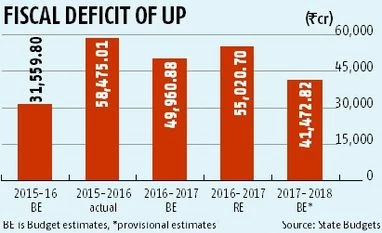
fiscal deficit of UP (Rs cr)
Ishan BakshiSanjeeb MukherjeeArup Roychoudhury New Delhi
Last Updated : Apr 06 2017 | 2:21 AM IST
On Tuesday, the Yogi Adityanath government in Uttar Pradesh announced waiver of farm loans of Rs 36,359 crore. But with the state’s fiscal deficit already at 4.45 per cent (Rs 55,020 crore) of its gross state domestic product in FY17 (revised estimates), the question is how will it raise the money to pay off banks? 

Various options have been proposed. 

A possible way out of this quagmire, one with limited impact on the state’s fiscal deficit, would be for the Uttar Pradesh government to direct a state entity to issue bonds. The proceeds from this can be used to pay off banks. 

Typically, state entities issue government-backed bonds to fund commercial projects. The revenue stream from these projects is used to pay off loans. These bonds do not reflect in the state Budgets and are thus not taken into consideration while estimating the state’s fiscal deficit, said experts. 

However, as there was no expected revenue stream in this case, the state government would have to make yearly provisions to pay off these loans. This amount could be transferred to the entity each year in the form of a grant and would reflect in the state Budget. Thus, only a part of the Rs 36,359-crore would reflect in the Budget each year, making the addition to the fiscal deficit more manageable. Data from the Reserve Bank of India showed that Uttar Pradesh already had outstanding guarantees of Rs 69,300 crore in 2013-14. 

“A state utility can raise these bonds which will then be guaranteed by the state within its limit,” said a senior retired bureaucrat of the Uttar Pradesh cadre who has served in the central and state governments. But he cautioned that raising such bonds was not easy.

There are other options, too. The state government could take over the entire amount of Rs 36,359 crore on its book but spread it over five years. This will lower its impact on the yearly fiscal deficit numbers. “Telangana adopted a similar approach, spreading the waiver over four years,” said another economist. 

B K Chaturvedi, former Cabinet secretary and a member of the erstwhile planning commission, said: “States cannot write off loans of public sector banks but can negotiate with them on the terms of repayment on behalf of farmers. They may get the loans restructured and pay over five years.”

UP could adopt an approach similar to that under UDAY, a revival package for electricity distribution companies. Under this, while banks would write off loans of farmers, the state would issue bonds that are then subscribed to by the banks.

“In such special cases, the central government can provide larger accommodation for the states’ borrowing programmes to fund such bonds. These bonds usually have lower interest rates as they are guaranteed by the state government. This can have an impact on the fiscal deficit of the state unless it manages to rationale its expenditure on other schemes,” said Chaturvedi. This would mean that UP would have to cut back on capital expenditure as revenue expenditure, which includes salaries and pensions.

But finance ministry officials have raised red flags at the Adityanath administration’s ability to issue bonds to finance the loan waiver. To issue instruments for the debt market, states have to maintain a healthy balance sheet so that ratings agencies can give investment-grade ratings to the bonds. 

Finance ministry officials have also ruled out the Centre directly helping the UP government in the matter by guaranteeing any issuance of bonds to waive farm loans. 

“There can be no preference to one state over the other on such issues. If you help one state, you have to help all states in a similar fashion,” said an official.

The state government could tap into other sources of finance such as public accounts to finance this additional burden. Of the budgeted fiscal deficit of Rs 31,559 crore in FY16, only Rs 18,700 crore or 59.2 per cent was proposed to be financed through market borrowings. The balance was budgeted to be financed from other sources such as special securities issues to the National Small Savings Fund, loans from LIC, Nabard, SBI and other banks, provident funds and reserve funds. 

While Uttar Pradesh might eventually find a way around the financing dilemma, the worry remains that this loan waiver might trigger demands for similar waivers in Punjab, Maharashtra and Tamil Nadu. 

The Madras High Court has already asked the state government to waive loans of all farmers and restrained co-operative societies and banks from recovering their dues, after the state had waived loans of small and marginal farmers.

One subscription. Two world-class reads.

Already subscribed? Log in

Subscribe to read the full story →
*Subscribe to Business Standard digital and get complimentary access to The New York Times

Smart Quarterly

₹900

3 Months

₹300/Month

SAVE 25%

Smart Essential

₹2,700

1 Year

₹225/Month

SAVE 46%
*Complimentary New York Times access for the 2nd year will be given after 12 months

Super Saver

₹3,900

2 Years

₹162/Month

Subscribe

Renews automatically, cancel anytime

Here’s what’s included in our digital subscription plans

Exclusive premium stories online

  • Over 30 premium stories daily, handpicked by our editors

Complimentary Access to The New York Times

  • News, Games, Cooking, Audio, Wirecutter & The Athletic

Business Standard Epaper

  • Digital replica of our daily newspaper — with options to read, save, and share

Curated Newsletters

  • Insights on markets, finance, politics, tech, and more delivered to your inbox

Market Analysis & Investment Insights

  • In-depth market analysis & insights with access to The Smart Investor

Archives

  • Repository of articles and publications dating back to 1997

Ad-free Reading

  • Uninterrupted reading experience with no advertisements

Seamless Access Across All Devices

  • Access Business Standard across devices — mobile, tablet, or PC, via web or app

Next Story



