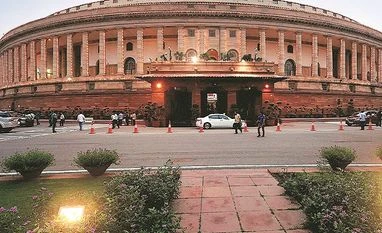
The government may move for legislative action on a new fiscal policy in the winter session of Parliament. Although the Fiscal Responsibility and Budget Management (FRBM) Committee has provided a draft Bill to replace the FRBM Act, policymakers in the Finance Ministry are deliberating whether to bring in changes through the proposed bill or amend the existing act.
“Deliberations on the FRBM panel’s recommendations are ongoing. If we see that incorporating new fiscal targets will not require a new Bill but rather the amendment of the existing FRBM Act, we will do that,” said a senior government official.
“Public comments are being awaited and there will be wide-ranging discussions. Any parliamentary action on the matter will only happen in the winter session or later,” the official said.
The FRBM panel has recommended a fiscal deficit target of 2.5 per cent of gross domestic product, revenue deficit of 0.8 per cent and a combined Centre-state debt ceiling of 60 per cent for fiscal year 2022-23, the end point of its six-year medium-term fiscal road map.
These and other recommendations, including setting up of a fiscal council and giving the government tightly defined escape clauses to deviate from the road map, form part of the draft Debt Management and Fiscal Responsibility Bill, drafted by the panel.
The panel had submitted its report to Finance Minister Arun Jaitley before Budget 2017-18. Its report was made public in April and the government has sought feedback from the public till May 5. Further discussions will start only after that, officials say.
The panel was headed by former Member of Parliament and Revenue and Expenditure Secretary N K Singh. Its other members include former Finance Secretary Sumit Bose, Reserve Bank of India Governor Urjit Patel, Chief Economic Advisor Arvind Subramanian, and Rathin Roy, director of National Institute of Public Finance and Policy.
Any amendment to the existing FRBM Act or a new fiscal policy law will come under ‘money Bill’ since it will dictate the central government’s borrowing in the coming years. Which means the passage will be required only in the Lok Sabha, where the ruling Bharatiya Janata Party has a comfortable majority. While the Bill or the amendments will be sent to the Rajya Sabha, the Upper House’s action on the Bill will not affect its eventual passage.
The panel’s report also contains a lengthy note of dissent from panel member and Chief Economic Advisor Arvind Subramanian, which states that the focus of policymakers should be on reducing primary deficit rather than fiscal deficit. In what could be a first, the other members of the panel have authored a rejoinder to Subramanian’s note.