GDP numbers indicate India's farmers are getting little for what they sow

The latest official numbers on the price of agricultural produce gives an idea of what's fueling the farmers' protest in Delhi.
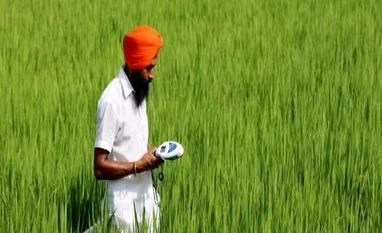
Agriculture, farming
Sanjeeb Mukherjee New Delhi
Last Updated : Nov 30 2018 | 11:58 PM IST
The latest numbers on the price of agricultural produce give an idea of what's fueling the farmers' protest in Delhi.

Gross value added (GVA) during the September quarter (the second for the financial year beginning April 1) in agriculture, forestry and fishing rose 3.8 per cent at constant prices but 2.8 per cent at current prices over a year. This means prices increased at a slower rate in the period, compared to a year before.

In contrast, the gap between GVA at constant and current prices during the corresponding period of 2017-18 was a positive 1.7 percentage points.

"Farmers aren't getting remunerative prices. They incur a huge loss in selling their produce below the state-mandated Minimum Support Price (MSP)," said a senior leader associated with the farmers' protest.

According to a government statement, the production of kharif crops in 2018-19 is expected to rise by 0.6 per cent as compared to 1.7 per cent during the same period last year. Which means less of output growth has not meant better prices.

"A GVA of 3.8 per cent in the second quarter of 2018-19 is surprising, given that production of several kharif crops could fall as per the First Advance Estimate for the year. I think production of the allied sector, which has 55 per cent share in agricultural GVA, contributed," Madan Sabnavis, chief economist at CARE Ratings, told Business Standard.

Around 55 per cent of the GVA of this sector is from livestock products, forestry and fisheries, where the combined growth was 6.7 per cent in Q2.

India's kharif grain production in the 2018-19 crop year that started in June is projected to touch an all-time high of 141.59 million tonnes (mt), up 0.6 per cent from last year. Despite an almost 10 per cent overall shortfall in monsoon, rains were distributed well and were timely.

The total area under kharif crops is estimated this year at close to one per cent more than last year. According to the First Advance Estimate, rice production is estimated at 99.24 mt, about 1.8 per cent more than the final estimate for 2017-18.

This is despite several parts of Bihar, Jharkhand and eastern UP experiencing drought-like conditions in the initial period of the four-month southwest monsoon season that started from June.

Coarse cereal output is estimated at 33.13 mt, around 2.2 per cent less than last year. Pulses' output is projected at 9.22 mt, from 9.34 mt last year. The drop is due to a shift towards sowing of soybean in place of more traditionally grown lentils in some parts of Madhya Pradesh and Maharashtra.

Total oilseed production is estimated at 22.18 mt, nearly 5.7 per cent more than last year's final estimate of close to 21 mt. Due mainly to a 22.6 per cent jump in soybean, despite a fall in groundnut production.

Cotton production is estimated at 32.48 mn bales (a bale is 170 kg), about 6.9 per cent less. And, jute production at 10.16 mn bales (each 180 kg), as against 10.13 mn bales last year.

One subscription. Two world-class reads.

Already subscribed? Log in

Subscribe to read the full story →
*Subscribe to Business Standard digital and get complimentary access to The New York Times

Smart Quarterly

₹900

3 Months

₹300/Month

SAVE 25%

Smart Essential

₹2,700

1 Year

₹225/Month

SAVE 46%
*Complimentary New York Times access for the 2nd year will be given after 12 months

Super Saver

₹3,900

2 Years

₹162/Month

Subscribe

Renews automatically, cancel anytime

Here’s what’s included in our digital subscription plans

Exclusive premium stories online

  • Over 30 premium stories daily, handpicked by our editors

Complimentary Access to The New York Times

  • News, Games, Cooking, Audio, Wirecutter & The Athletic

Business Standard Epaper

  • Digital replica of our daily newspaper — with options to read, save, and share

Curated Newsletters

  • Insights on markets, finance, politics, tech, and more delivered to your inbox

Market Analysis & Investment Insights

  • In-depth market analysis & insights with access to The Smart Investor

Archives

  • Repository of articles and publications dating back to 1997

Ad-free Reading

  • Uninterrupted reading experience with no advertisements

Seamless Access Across All Devices

  • Access Business Standard across devices — mobile, tablet, or PC, via web or app

Next Story



