Govt cuts capex two months in a row to contain fiscal deficit

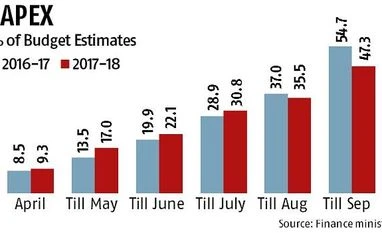
Consequently, capex down to 47.3% of Budget Estimate in H1 of FY18 from 54.7% a year ago
graph
graph
Indivjal Dhasmana New Delhi
Last Updated : Nov 03 2017 | 2:19 AM IST
The government had to cut expenditure, including on the much-needed capital front, in September for a second month in a row, to control its fiscal deficit.  

The squeeze on capital expenditure (capex) was so much that it declined even cumulatively as a percentage of Budget expenditure in the first half of 2017-18, compared with the year-ago period.

Capex was Rs 1,46,389 crore in April-September, the financial year’s first half (H1), which was 47.3 per cent of the Budget Estimate (Rs 3,09,230 crore) against 54.7 per cent of BE in H1 last year. However, in absolute numbers, it rose 8.5 per cent in the first half. 

Capex in September was cut 16 per cent year-on-year, to Rs 37,741 crore. In August, the cut was 28 per cent, to Rs 14,522 crore. 

Revenue expenditure, that does not go into creating assets, was also compressed by 11 per cent to Rs 1,61,999 crore in the first half. “Revenue expenditure growth stood at 12.3 per cent in H1, outpacing capital expenditure growth (8.5 per cent), a dip in the quality of expenditure,” says Aditi Nayar, principal economist with ratings agency ICRA. She says defence, roads and railways led capex in H1.

This compression of spending helped the Centre to have a fiscal surplus of Rs 26,107 crore in September. That led to the fiscal deficit coming down to Rs 4.98 lakh crore in the month, from Rs 5.25 lakh crore in August. Or, from 96 per cent of the BE in August to almost 91 per cent in September.

Where and how much the squeeze is in subsequent months, or not, remains to be seen. The year’s fiscal deficit at targeted at 3.2 per cent of the country’s gross domestic product. A squeeze might be needed, to offset slippage in revenue from telecom spectrum auction and disinvestment, as well as the lower surplus transferred by the Reserve Bank. Devendra Pant, chief economist with India Ratings, says this has been the past experience.  

However, there would not be pressure from recapitalised bonds for public sector banks. "There is low likelihood that a potential fiscal stimulus or accounting for bank recapitalisation bonds would trigger a meaningful fiscal slippage," Nayar says.

One subscription. Two world-class reads.

Already subscribed? Log in

Subscribe to read the full story →
*Subscribe to Business Standard digital and get complimentary access to The New York Times

Smart Quarterly

₹900

3 Months

₹300/Month

SAVE 25%

Smart Essential

₹2,700

1 Year

₹225/Month

SAVE 46%
*Complimentary New York Times access for the 2nd year will be given after 12 months

Super Saver

₹3,900

2 Years

₹162/Month

Subscribe

Renews automatically, cancel anytime

Here’s what’s included in our digital subscription plans

Exclusive premium stories online

  • Over 30 premium stories daily, handpicked by our editors

Complimentary Access to The New York Times

  • News, Games, Cooking, Audio, Wirecutter & The Athletic

Business Standard Epaper

  • Digital replica of our daily newspaper — with options to read, save, and share

Curated Newsletters

  • Insights on markets, finance, politics, tech, and more delivered to your inbox

Market Analysis & Investment Insights

  • In-depth market analysis & insights with access to The Smart Investor

Archives

  • Repository of articles and publications dating back to 1997

Ad-free Reading

  • Uninterrupted reading experience with no advertisements

Seamless Access Across All Devices

  • Access Business Standard across devices — mobile, tablet, or PC, via web or app

Next Story



