Of the total Mahatma Gandhi National Rural Employment Gurantee Act (MGNREGA) job cards that the government has physically verified, only 1.42 per cent have been found to be either duplicate or fraudulent.
The exercise was carried out without the use of Aadhaar as a source of authentication of beneficiaries.
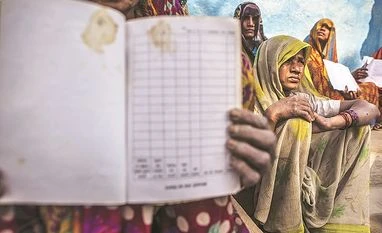
The government has so far verified 84.4 million of the 124.9 million MGNREGA cards distributed to workers across the country. Of these, 9.47 million cards have been deleted through door-to-door verification, but only 1.2 million because of their being either duplicate or fraudulent.
Other key reasons for the deletion of cards include the families (0.86 million) having shifted from the gram panchayat where they were registered, or the families (0.38 million) not found living in the specific gram panchayat (GP).
According to information provided by the rural development ministry, the largest chunk of job cards (5.89 million) was deleted for “other” reasons, which are not specified. Another one million cards were deleted because workers wanted to surrender these, as they were no more dependent on the scheme for livelihood.
The ministry told Business Standard that while these 9.47 million cards have been deleted over a year and a half, another 7.3 million fresh job cards have been included in financial year 2016-17.
When the NDA government took over in 2014, it showed reluctance in the first year to promote the scheme, claiming it to be inefficient. This led to a crash, and the work provided under the scheme fell to an all-time low in 2014-15. But then the government revived its interest in the scheme.
Under the scheme, every household is given one job card, and all members of that family seeking work are registered as workers on that card. At the moment, there are 124.9 million job cards with 242 million registered workers.
The physical verification drive was conducted following an evaluation of the scheme in 29 gram panchayats in eight select states that showed 10 per cent of the job cards were inoperative.
Business Standard asked the ministry of rural development if any action had been taken to recover the money given under the scheme over the past several years against the 1.2 million cards that were found to be duplicate or fraudulent. “Action against erring officials is carried out by the competent authorities of the states. The verification process is still on in campaign mode. The information is being collected as regards any penal action taken,” the ministry said. Sources in the ministry, however, said it had not yet sought to initiate any penal action against either officials or other citizens in these cases.
The work to link the MGNREGA workers’ job cards to their Aadhaar numbers has been going on simultaneously, as decided at the highest level in the government. So far, the government has linked less than 50 per cent of the 242 million registered workers to their Aadhaar numbers. But, when asked, the ministry said it had not yet assessed if the linking to Aadhaar had helped detect any fraud or duplication.
The government has often touted the ability to detect frauds and duplicates as the key advantage of linking databases of beneficiaries under different schemes to Aadhaar numbers. MGNREGA regulations lay down a clear procedure for deleting a job card. The ministry in its response to queries said, “In all cases, the programme officer, after independent verification of the facts, may direct the gram panchayat to cancel the job cards. All additions, deletions or cancellations must be made public, presented to the gram sabha or the ward sabha, reported to the programme officer and updated in the management information system.”
Like all other ministries that have linked the beneficiary of the schemes they administer to Aadhaar, the rural development ministry, too, has done so for workers under the MGNREGA. It has said either workers provide the Aadhaar number or the proof of enrolment for Aadhaar.
A worker can continue to get work under the scheme till September 30 as long as he or she provides the proof of enrolment along with the job card and another form of identification. The presumption, like in many other schemes, is that, after this deadline providing Aadhaar would become mandatory. But the ministry insists that no one is being denied work for the lack of Aadhaar and it remains voluntary.





