Growing inequality can be a potential threat to economy: Manmohan Singh

The former PM also said atrocities against minorities and Dalits were increasing in the country, and called for rejection of 'divisive policies and politics'
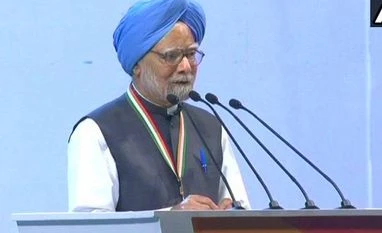
manmohan Singh
Manmohan Singh. Photo: ANI
Archis Mohan New Delhi
4 min read Last Updated : Apr 08 2019 | 3:55 PM IST
Former prime minister Manmohan Singh on Wednesday said growing inequality in India could pose a "grave danger" to both the country’s democracy as also to sustained growth.

Delivering the first SB Rangnekar Memorial lecture at the Panjab University, his alma mater, in Chandigarh, the former PM said that India “must preserve strategic autonomy in decision making processes and resist the temptation of rich rewards gained by becoming a tool in the great games of big powers in the pursuit of their imperial ambitions.”

Singh said economic growth remained a high priority for India, but bemoaned the “weakening” of the accompanying commitment to ensure that disparities and inequality do not grow. He also criticised the abolition of the Planning Commission by the Narendra Modi government.

The former PM also said atrocities against minorities and Dalits were increasing in the country, and called for rejection of "divisive policies and politics".

The former PM said a "dangerous and false binary" of choosing between freedom and development was surfacing in the country's political discourse and it must be rejected. He said India’s electoral system was being undermined by the use of money and muscle power and called for electoral reforms.

On the issue of increasing inequality, the former PM said: “Development planning, and the Planning commission, were designed to ensure that while the economy grew, inequality did not grow. With the abolition of the Planning Commission, fresh efforts have to be made to keep inequalities under control.”

Singh said the economic liberaliSation that he was associated with “in 1991-1996 and 2004-2014” was, above all, a process of opening up new opportunities for people born without social and economic privilege. “This was for me the guiding vision behind our economic reforms,” he said.

He said there was now “a growing concern that the concomitant commitment to ensuring that disparities and inequality do not grow is weakening.” He said this “can be a serious potential threat to our democracy.”

Singh said: “economists and development experts worldwide, including in India, are today emphasiSing the grave danger to sustained growth from growing inequality.”

The former prime minister termed it “vitally important” for India “to maintain strong focus on containing the growth of economic inequality, and work actively to reduce it.”

“What is required is stronger social and political reawakening to the principle of equality – social, economic and political – for the sake of equality and as a mark of our commitment to democracy.”

“In the short term, pro-equality policies may make growth more expensive, but the growing inequality is, in the long term, a far greater danger to economic well-being and sustained growth,” he said.

Singh said the increase in atrocities against minorities and dalits, if unchecked, can harm India’s democracy. Singh said people’s faith in democracy is being eroded as much by a sustained campaign to attack democratic institutions and elected representatives as by the increasing political corruption and the capture of political parties and elected office by vested interests.

“We need to ask ourselves whether we are losing patience with democracy and turning to more authoritarian alternatives that may well yield superior short-term results but in the long term will end up destroying our country and all the achievements of the last seventy years”,” he said.

The former PM said governance is “complex”, “messy” and “slow”. “Its benefits are long term. It requires great patience”. He said democracy is a system in which people without privilege have a decisive voice in governance. “If this is lost, democracy becomes meaningless,” he said, and called for everyone to get involved in strengthening democracy.

One subscription. Two world-class reads.

Already subscribed? Log in

Subscribe to read the full story →
*Subscribe to Business Standard digital and get complimentary access to The New York Times

Smart Quarterly

₹900

3 Months

₹300/Month

SAVE 25%

Smart Essential

₹2,700

1 Year

₹225/Month

SAVE 46%
*Complimentary New York Times access for the 2nd year will be given after 12 months

Super Saver

₹3,900

2 Years

₹162/Month

Subscribe

Renews automatically, cancel anytime

Here’s what’s included in our digital subscription plans

Exclusive premium stories online

  • Over 30 premium stories daily, handpicked by our editors

Complimentary Access to The New York Times

  • News, Games, Cooking, Audio, Wirecutter & The Athletic

Business Standard Epaper

  • Digital replica of our daily newspaper — with options to read, save, and share

Curated Newsletters

  • Insights on markets, finance, politics, tech, and more delivered to your inbox

Market Analysis & Investment Insights

  • In-depth market analysis & insights with access to The Smart Investor

Archives

  • Repository of articles and publications dating back to 1997

Ad-free Reading

  • Uninterrupted reading experience with no advertisements

Seamless Access Across All Devices

  • Access Business Standard across devices — mobile, tablet, or PC, via web or app

Next Story



