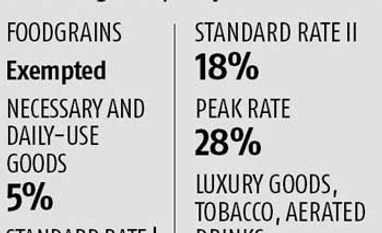
The Goods and Services Tax (GST) Council on Thursday decided upon a 4-slab tax structure of 5 per cent, 12 per cent, 18 per cent and 28 per cent, with lower rates for essential items and the highest for luxury and de-merits goods, many of which would also attract an additional cess. A proposal by some states, including Kerala, to have special GST rates on luxury and sin goods was not accepted.
On Friday, the Council will take up the prickly issue of administrative control over assessees. The Centre has proposed “cross-empowerment” whereby both the Centre and states will have powers to scrutinise and audit all assessees.
Finance Minister Arun Jaitley told reporters after Thursday’s meeting that about 50 per cent of the consumer price index basket will be taxed at zero rate, with a view to keep inflation under control. This will include essential food grains and items consumed by the masses. However, Revenue Secretary Hasmukh Adhia later clarified that food grains would be GST exempt and not zero-rated and would not qualify for input credit.
“You don’t even require input tax credit on wheat and rice. So, they will be exempted,” Adhia said.
The lowest rate of five per cent (down from six per cent proposed earlier) would be for common use items while there would be two standard rates of 12 per cent and 18 per cent, Jaitley said.
The finance minister said highest tax slab of 28 per cent will be applicable to items which are currently taxed at 30-31 per cent (excise duty plus VAT). However, a lot of the items in this category which are mass consumed by middle and lower-middle classes, like soaps and detergents, could be brought under the 18 per cent slab, he added.
Luxury cars, tobacco and aerated drinks would also be levied with an additional cess on top of the highest tax rate. The idea would be to keep the total tax plus cess similar to the levy charged on these items now, Jaitley said.
The collection from this cess as well as that of the clean energy cess would create a revenue pool which would be used for compensating states for any loss of revenue during the first five years of implementation of GST. The cess, he said, would be lapsable after five years.
Jaitley said about Rs 50,000 crore would be needed to compensate states for loss of revenue from rollout of GST, which is to subsume a host of central and state taxes like excise duty, service tax and VAT, in the first year.
Adhia said if there is a surplus amount of cess after compensating states, it will be divided equally between Centre and states.
Though rate of cess has not yet been decided, the revenue secretary said it could be even 100 per cent on certain items. “Total incidence on those demerit items will not go down,” he said.
The revenue secretary said some additional items, whose incidence of tax is more than 31 per cent, may face a cess.
Whether cess will continue after five years or not will be decided in the fourth year by the GST Council. Whether there will be a cess or it would be merged with the GST rates would be decided after five years. Also, incidence of tax on demerit goods will not come down. But the form of collection will be decided by the GST Council.
The 4-tier tax structure has slight modification to the 6, 12, 18 and 26 per cent slabs that were discussed by the GST Council last month.
Adhia said most services will come under 18 per cent slab. Some cases where abetment is given will be taxed lower. “There will be some services, which will attract 12 per cent or five per cent also,” he said.
While the Centre proposed to levy a 4 per cent GST on gold, a final decision was put off, Jaitley said. Finance Secretary Ashok Lavasa said, “Now, you have a system by which additional burden of compensating the states is not being passed to consumers in a way it would have otherwise passed on in terms of taxes. So, this is very reasonable arrangement that has been agreed to keeping in view the interest of consumer and state governments.”
WHAT NEXT ON GST? - Administrative control to be discussed by GST council on Friday
- Council again meets on Nov 9 and 10 to discuss model GST Bills
- On the basis of model Bills, IGST, CGST Bills to be framed and likely to be tabled in winter session of Parliament
- Panel to decide on goods and services to be put under each tax slab
- States to pass their own versions of SGST, based on model Bills
- If things go as per plan, GST to roll out on April 1, 2017

 "GST Council finalises peak rate at 28%")












 Connect with us on WhatsApp