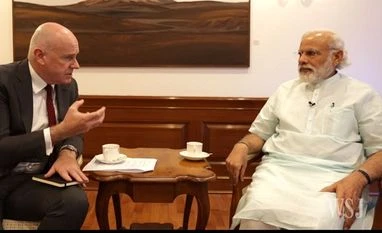
Prime Minister Narendra Modi, in an interview given to the
Wall Street Journal on the eve of completing two years in office, countered critics who say he has failed to bring in "big bang" reforms and said that many of the changes brought in by him would have been considered difficult by previous administrations.
Modi told the financial daily that he has undertaken "the maximum reforms" and added that he has set an "enormous task" ahead for himself.
The Prime Minister also said his government had made it easier for foreign investment to enter the country, taken steps to curb corruption, filled gaps in rural infrastructure and enhanced the ease of doing business.
The Wall Street Journal has said that though Modi "has pursued a series of incremental, and not always glamorous, changes aimed at re-energising a struggling economy, he hasn’t emerged as the rapid liberaliser that some investors had hoped".
However, the Prime Minister appears to disagree with the notion of "big bang" measures. He told the editor-in-chief of the international daily: “When I came to the government, I used to sit down with all the experts and ask them to define for me what is the ‘big bang’ for them...Nobody could tell me.”
Here is what the Prime Minister told the Wall Street Journal on several issues:
1) Land acquisition: On the contentious issue of land acquisition laws, Modi said that efforts to amend the existing law at the central level were “over now”. In stead, he said that it was upto the states to pursue amendments and changes according to their needs.
2) Labour reforms: The Prime Minister said that he would look to individual states for moving the needle on labour laws and bring in reforms. “Labour reform should not just mean in the interest of industry. Labour reform should also be in the interest of the labourer,” he said.
3) Divestment in PSUs: Asserting that the public sector had its own role to play in India's development, Modi said, “In any developing country in the world, both the public sector and the private sector have a very important role to play. You can’t suddenly get rid of the public sector, nor should you.”
4) Goods and Services Tax: Speaking on the issue of bringing in the politically-hot and long-delayed goods and services tax, the Prime Minister said that he expects the concerned legislation to pass this year.
5) China, the US and India: Stressing on the need for countries to cooperate, Modi, according to the Wall Street Journal, "downplayed" any friction with China.
In the “relationship between China and the US, there are areas where they have substantial differences but there are also areas where they work closely,” Modi said, adding, “This is the new way. If we want to ensure the success of this interdependent world, I think countries need to cooperate, but at the same time we also need to ensure that there is respect for international norms and international rules.”
On India's continued and ever-growing engagement with the US on various issues, he said, “Today, unlike before, India is not standing in a corner.”
6) Relationship with President Barrack Obama: Speaking about the rapport he shares with President Obama, Modi said, "President Obama had sent me an invitation in March. And later when I went for the Nuclear Security Summit, he had personally requested me. And it was on my request that he had visited India again. Naturally it was my responsibility too. And we've also developed a kind of friendship where we can speak freely with each other."
7) Defence sector: Speaking on the topic of defence manufacturing, Modi said that as far as that sector is concerned, India definitely wants to move ahead given the large import bill incurred by the country in that regard. Modi added that from an economic point of view, defence equipment manufacturing could provide "maximum" number of jobs to the Indian youth. He said that he has been talking to many countries and working hard in this regard.
8) Relations with Pakistan: Responding to a question regarding the possibility of the US wanting India to do more to normalise relations with Pakistan, Modi said that he had taken steps on his own initiative to do just that and referred to the invitation sent to the heads of state of all SAARC nations during the swearing in of his government. However, he made it clear that terrorism and acts of terror could not be tolerated, implicitly pointing at Pakistan's continued support for terrorist organisations which target India.
Video source: Wall Street Journal videos, YouTube

 "Have undertaken 'maximum reforms', PM Modi tells international financial daily")


