Heavy rain helps Assam tea industry clear stock, but production to decline

In 2016, the Indian tea industry registered a bumper crop at 1,233 million kg
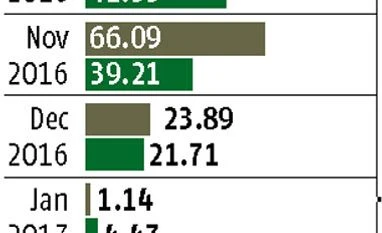
graph
Avishek Rakshit Kolkata
Last Updated : Apr 06 2017 | 12:55 AM IST
Tea plantations in Assam are facing a production dip because of excessive rain. This might help sell off a 24-million-kg carryover stock at stable prices. 

Industry sources said the situation would help balance availability at tea auctions and help fetch expected prices. Had production been normal at 30 million kg in March, it would have affected the forthcoming auctions as this tea would have gone under the hammer along with the carryover stock.

Auction prices of CTC (crush, tear, curl) tea opened at expected levels in January at Rs 142.07 a kg in Kolkata and Rs 123.86 a kg in Guwahati but declined thereafter to Rs 105.09 a kg in Kolkata and Rs 109.54 a kg in Guwahati. Industry executives attribute this to excess availability of tea last year and carryover stock.

Production declined by 50 per cent in March in Assam compared to last year, said Azam Monem, chairman of the Indian Tea Association. “Prices at auctions are expected to remain firm as the March production is low,” he added.

India had a bumper tea crop in 2016 at 1,233 million kg with Assam, which accounts for 52 per cent of the country’s tea production, registering a seven per cent output growth.  Average auction prices of CTC tea during the year rose three per cent to Rs 148 a kg.

The Cachar region, which contributes 20 per cent of Assam’s  annual tea output of 600 million kg, was most affected by rain and hail this March. “In April, there will be some recovery in prices as well as production,” Monem said.

However, the net earnings of tea plantations are likely to fall in the near term. “The investment for this season is nearly lost,”  said A N Singh, managing director, Goodricke.

S S Bagaria, former chairman of the Darjeeling Tea Association, said gardens in West Bengal had lost 65 per cent of the March output, which would heavily affect the first flush. Tea harvested in March-April fetches a premium over other flushes.

Darjeeling tea does not have a carryover stock. “The heavy rainfall in Darjeeling  comes just at a time when leaves had started fetching 10 per cent more than the previous year,” Bagaria said.

Shortage-driven price increases will not compensate for the revenue Darjeeling tea producers were expecting during the prime season. The first flush comprises 34 per cent of the eight million kg annual tea production in Darjeeling and contributes over 35 per cent to the earnings of these tea gardens.

One subscription. Two world-class reads.

Already subscribed? Log in

Subscribe to read the full story →
*Subscribe to Business Standard digital and get complimentary access to The New York Times

Smart Quarterly

₹900

3 Months

₹300/Month

SAVE 25%

Smart Essential

₹2,700

1 Year

₹225/Month

SAVE 46%
*Complimentary New York Times access for the 2nd year will be given after 12 months

Super Saver

₹3,900

2 Years

₹162/Month

Subscribe

Renews automatically, cancel anytime

Here’s what’s included in our digital subscription plans

Exclusive premium stories online

  • Over 30 premium stories daily, handpicked by our editors

Complimentary Access to The New York Times

  • News, Games, Cooking, Audio, Wirecutter & The Athletic

Business Standard Epaper

  • Digital replica of our daily newspaper — with options to read, save, and share

Curated Newsletters

  • Insights on markets, finance, politics, tech, and more delivered to your inbox

Market Analysis & Investment Insights

  • In-depth market analysis & insights with access to The Smart Investor

Archives

  • Repository of articles and publications dating back to 1997

Ad-free Reading

  • Uninterrupted reading experience with no advertisements

Seamless Access Across All Devices

  • Access Business Standard across devices — mobile, tablet, or PC, via web or app

Next Story



