Home / Economy / News / India's FY17 GDP projected to slow to 6.6% post-demonetisation: IMF
India's FY17 GDP projected to slow to 6.6% post-demonetisation: IMF
However, IMF says GDP might rebound to 7.2% in FY18
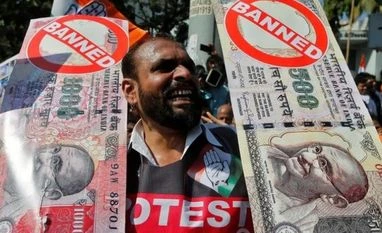
A man holds placards and shouts slogans during a rally organized by India's main opposition Congress party against the government's decision to withdraw 500 and 1000 Indian rupee banknotes from circulation (Photo: Reuters)
India's growth is projected to slow to 6.6 per cent in 2016-17 financial year due to the strains that have emerged in the economy as a result of "temporary disruptions" caused by demonetisation, the IMF said on Wednesday.
In its annual report, the International Monetary Fund (IMF) said demonetisation would have only short-term impact on the economy and it would bounce back to its expected growth of more than eight per cent in the next few years.
The post-November 8, 2016 cash shortages and payment disruptions caused by the currency exchange initiative have undermined consumption and business activity, posing a new challenge to sustaining the growth momentum, the IMF said in its annual country report on India.
"Growth is projected to slow to 6.6 per cent in FY17, then rebound to 7.2 per cent in FY18, due to temporary disruptions, primarily to private consumption, caused by cash shortages," it said.
India's economy grew at 7.6 per cent in 2015-16.
Tailwinds from a favourable monsoon, low oil prices and continued progress in resolving supply-side bottlenecks, as well as robust consumer confidence, will support near-term growth as cash shortages ease, the IMF said.
The investment recovery is expected to remain modest and uneven across sectors, as deleveraging takes place and industrial capacity utilisation picks up, the report said.
In their report, the IMF Directors supported the Indian efforts to clamp down on illicit financial flows but noted "the strains that have emerged" from the currency exchange initiative.
"They called for action to quickly restore the availability of cash to avoid further payment disruptions and encouraged prudent monitoring of the potential side-effects of the initiative on financial stability and growth," the report said.
Noting India's strong economic performance of the past few years, the IMF Executive Directors commended New Delhi for its strong policy actions, including continued fiscal consolidation and an anti-inflationary monetary policy, which have underpinned macroeconomic stability.
As such, the IMF recommended continued vigilance to potential domestic and external shocks and urged the authorities to further advance economic and structural reforms to address supply bottlenecks, raise potential output, create jobs, and ensure inclusive growth.
The IMF feels that on the external side, despite the reduced imbalances and strengthened reserve buffers, the impact from global financial market volatility could be disruptive, including from US monetary policy normalisation or weaker-than-expected global growth.

 "India's FY17 GDP projected to slow to 6.6% post-demonetisation: IMF")


