An India-Russia corridor could be New Delhi's answer to China's OBOR

INSTC's significance might have just gone up as India expressed its reservations against OBOR
obor
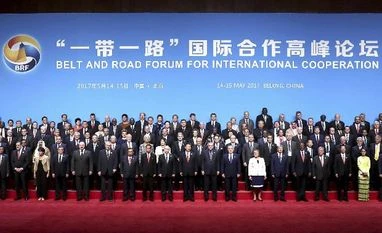
In this photo released by Xinhua News Agency, Chinese President Xi Jinping, center, and countries' leaders and delegates attending the Belt and Road Forum pose for a group photo on stage at the China National Convention Center in Beijing (Photo: AP/P
BS Web Team New Delhi
Last Updated : May 15 2017 | 11:38 AM IST
Does India have an answer to China's 'One Belt, One Road' (OBOR) project and its contentious component, the China-Pakistan Economic Corridor (CPEC)? Only time will tell. However, India is a founding member of the International North-South Transport Corridor (INSTC), a multi-nation project to create transport and logistics infrastructure akin to OBOR. 

INSTC's significance might have just gone up as India expressed its reservations against OBOR, refusing to attend China's Belt and Road Forum summit on Sunday following concerns regarding sovereignty over the CPEC. With China moving ahead and securing the endorsement of even the US, the European Union and Asian rival Japan for its initiative, India should lay emphasis on its own transport and trade corridor project. 

What is the INSTC

A geostrategic initiative being pushed by India to connect with Central Asia and Russia, INSTC's second dry run was reportedly conducted in April this year. 

The roughly 7,200 kilometre-long INSTC is a proposed multi-modal (ship, rail and road) transportation system connecting the Indian Ocean and Persian Gulf to the Caspian Sea via the Islamic Republic of Iran, from where it connects St Petersburg, Russia, and North Europe. (Read more)

According to the Russia & India Report, "The main route begins in Mumbai, passes along the sea to the Iranian ports of Chabahar and Bandar Abbas, and from there by land to Iran’s Caspian Sea coast and beyond – or across the Caspian Sea to Astrakhan, or overland to Central Asia or the Caucasus to Russia and northern Europe." 

INSTC is expected to slash time for transportation of cargo to Russia from India by half to about 30 days. (Read more)

According to a Livemint report on the dry run of the corridor, Indian government officials have said that the INSTC could reduce the time and cost of deliveries by 30-40 per cent. Also, the INSTC is much shorter than the current route, which runs through the Suez Canal and the Mediterranean Sea. Citing the officials, the report added that goods transported through the Suez take 45-60 days to reach Europe, while those transported through INSTC would take 25-30 days. 

INSTC's viability also depends upon the Chabahar port in Iran. Situated on the Makran Coast of the Sistan and Baluchestan province of Iran, Chabahar will also serve as a trans-shipment and logistics hub for the INSTC. 

India and Iran had in 2003 agreed to develop Chabahar on the Gulf of Oman outside the Strait of Hormuz, near Iran's border with Pakistan.

One subscription. Two world-class reads.

Already subscribed? Log in

Subscribe to read the full story →
*Subscribe to Business Standard digital and get complimentary access to The New York Times

Smart Quarterly

₹900

3 Months

₹300/Month

SAVE 25%

Smart Essential

₹2,700

1 Year

₹225/Month

SAVE 46%
*Complimentary New York Times access for the 2nd year will be given after 12 months

Super Saver

₹3,900

2 Years

₹162/Month

Subscribe

Renews automatically, cancel anytime

Here’s what’s included in our digital subscription plans

Exclusive premium stories online

  • Over 30 premium stories daily, handpicked by our editors

Complimentary Access to The New York Times

  • News, Games, Cooking, Audio, Wirecutter & The Athletic

Business Standard Epaper

  • Digital replica of our daily newspaper — with options to read, save, and share

Curated Newsletters

  • Insights on markets, finance, politics, tech, and more delivered to your inbox

Market Analysis & Investment Insights

  • In-depth market analysis & insights with access to The Smart Investor

Archives

  • Repository of articles and publications dating back to 1997

Ad-free Reading

  • Uninterrupted reading experience with no advertisements

Seamless Access Across All Devices

  • Access Business Standard across devices — mobile, tablet, or PC, via web or app

Next Story



