India taking steps to complete transition into clean energy: Jitendra Singh
Union minister Jitendra Singh said that India is taking steps for the development of Small Modular Reactors (SMR), with up to 300 MW capacity to fulfill its commitment to the Clean Energy transition
ANI General News Union Minister of State Jitendra Singh on Sunday said that India is taking steps for the development of Small Modular Reactors (SMR), with up to 300 MW capacity to fulfill its commitment to the Clean Energy transition, said a press release by Department of Atomic Energy.
In his address to a Workshop on Small Modular Reactors (SMR) organized by NITI Aayog and the Department of Atomic Energy, Jitendra Singh said, the participation of the private sector and Start-ups needs to be explored in the development of this critical technology within India. He emphasized that technology sharing and the availability of funding are the two crucial links for ensuring the commercial availability of SMR technology, added the statement.
Singh said, the exploration of new clean energy options is in tune with Prime Minister Modi's roadmap for clean energy transition through bold climate commitments which are reflected in our updated Nationally Determined Contributions (NDCs).
Singh pointed out that as we have already taken steps for clean energy transition with penetration of non-fossil based energy resources and achieving net-zero by 2070, nuclear in terms of baseload power can play a big role in the de-carbonization strategy. It is in this context that the role of nuclear energy will be critical for the clean energy transition of not just India but for the entire world, the Minister added.
Small Modular Reactors (SMR), with up to 300 MW capacity by nature are flexible in design and require a smaller footprint. Being mobile and agile technology, SMR can be factory-built, unlike the conventional nuclear reactors that are built on-site.
Thus, SMRs offer significant savings in cost and construction time. SMR is a promising technology in industrial de-carbonization, especially where there is a requirement for reliable and continuous supply of power. It is said that SMR is simpler and safer as compared to large nuclear plants.
Singh said an impressive number of measures have been taken to promote renewable energy in the country and India today stands at number four in the RE installed capacity across the world, after China, Europe, and United States. He added that these measures also conform to the Prime Minister's Aatmanirbhar Bharat goal, where India contributes significant value to the global value chain.
It must be noted that India, comprising 17 percent of the world population has seen its primary energy growing at a rate of 4 percent during the last decade, almost double the global growth rate of 1.3 percent. However, by historical standards, our share in global emissions is less than 5 percent.
(Only the headline and picture of this report may have been reworked by the Business Standard staff; the rest of the content is auto-generated from a syndicated feed.)

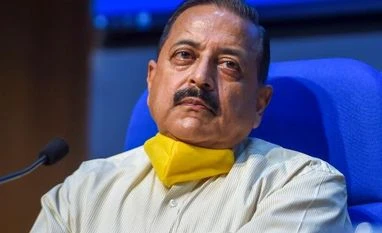 "India taking steps to complete transition into clean energy: Jitendra Singh")


 Connect with us on WhatsApp