Retail inflation up at 7.96% on costly food items
Data justify RBI's stance of not cutting policy rate at its review earlier this month
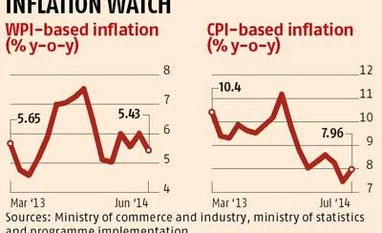
BS Reporter New Delhi Pushed by food items, the Consumer Price Index (CPI)-based inflation rose to 7.96 per cent in July from 7.46 per cent in June, which was an all-time low since the new series was launched in January 2011.
The official data, issued on Tuesday, justified the Reserve Bank of India’s stance of not cutting the policy rate at its review earlier this month. However, inflation in July was still the third lowest in the series. Beside June 2014, it was only in January 2012 that inflation was lower than this July. In January 2012, it was 7.55 per cent.
Besides, it was quite below the 9.64 per cent rise in July 2013. Inflation in June was revised up from the earlier estimate of 7.31 per cent.
The data, released by the ministry of statistics and programme implementation, showed the distribution of inflation between rural and urban parts had undergone a change over the year. In July, rural inflation stood higher at 8.45 per cent against 7.42 per cent in urban parts. However, a year before (July 2013), urban inflation was 10.18 per cent, above the 9.14 per cent in villages.
In both urban and rural areas, inflation rose compared to the previous month of June, when it had stood at 7.87 per cent in villages and 6.82 per cent in urban parts.
The inflation in July rose mainly due to the rate of price rise in food items, which have 45 per cent weight in the CPI. Food inflation increased to 9.36 per cent in July against 8.05 per cent in June. It was 11.22 per cent in July 2013.
The data came on the day the India Meteorological Department cut its forecast for monsoon rain to 87 per cent of the long period average against its earlier projection of 93 per cent.
The low monsoon rain might mainly affect production of pulses and oilseeds. Inflation in both these food categories was manageable in July, even as it rose 5.85 per cent in the month against 5.17 per cent in June. Edible oil saw inflation at 0.7 per cent in July against 0.35 per cent the previous month.
In fact, these were other commodities, particularly vegetables and fruit, which witnessed quite higher inflation. Vegetable prices rose 16.88 per cent in July year-on-year, against 8.73 per cent in the previous month and fruits turned more expensive by 22.48 per cent against 20.64 per cent in June.
Inflation in milk was 11.26 per cent against 11.06 per cent. However, inflation in fish, meat and eggs fell to 7.68 per cent against 8.28 per cent.
Aditi Nayar, senior economist with ICRA, said, “Food inflation rose in the just-concluded month...The delayed sowing of crops, as well as the shortfall in area covered so far, suggest that prices might remain firm in the coming months, a key concern for ensuring CPI at or below eight per cent in January 2015.”
RBI has targeted to keep CPI inflation at eight per cent in January 2015 and bringing it down to six per cent by January 2016.
Nayar said any improvement in demand conditions could prevent a sustained easing of inflationary pressures. “With such factors posing upside risks to the inflation target of six per cent for January 2016, RBI would continue to focus on reining in inflationary expectations, resulting in a low likelihood of monetary easing in the remainder of 2014.”
Fuel and light prices rose 4.47% in July on a yearly basis, against 4.58% in June.
Inflation in clothing, bedding and footwear declined to 7.31% in July against 8.65% in June.
ALSO READ: Vegetable prices surge again, put pressure on CPI inflation
 "Retail inflation up at 7.96% on costly food items")


 Connect with us on WhatsApp