Kharif output to be lowest in 5 years
Fall in oilseeds, pulses could push up retail prices; rice decline not much and buffer stock is adequate
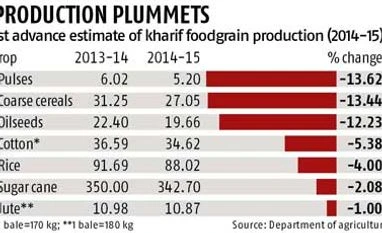
BS Reporter New Delhi The kharif season’s foodgrain output is expected to fall to a five-year low to 120.27 million tonnes, a decline by almost nine million tonnes (mt) over that in the same period last year, due to the uneven southwest monsoon in the first part of the season. There could be adverse repercussions on rabi crops as well, which could hinder agriculture growth in the remaining three quarters of the current financial year. The first advance estimate of production was issued on Friday. The biggest impact of the erratic rain is expected to be on coarse cereals, pulses and groundnuts. Production of rice, the bulk grain grown this season, is estimated to be 88.02 mt, four per cent less than last year’s.
“Due to lower area coverage and productivity, production of most crops is expected to be lower than their record production levels last year,” went an official statement.
Coarse cereal production is expected at 27.05 mt as against 31.25 mt in 2013-14, down 13.4 per cent.
Production of pulses is expected to be 5.2 mt as against 6.02 mt last year. Oilseeds is expected to be 19.66 mt, down from 22.4 mt.
“A drop in oilseeds, pulses and coarse cereals in the kharif season will definitely have an impact on prices, as most of these are a single-season crop and usually don’t have big stocks. In rice, there is not much impact seen on prices as the huge government stocks will buffer against it. I feel this estimate of crop production will be high on the Reserve Bank’s agenda when it reviews its monetary policy next, as in the case of oilseeds and pulses, import dependence will increase,” said Madan Sabnavis, chief economist, CARE Ratings.
The biggest fall in oilseeds has been in groundnuts. Production is estimated at 5.02 mt, almost 36 per cent less than last year’s kharif.
Issuing the estimate, Agriculture Minister Radha Mohan Singh said the aim would be to try to achieve last year's level despite the adverse weather, with drought in some parts and floods in some others.
Production of cotton in 2014-15 is expected to be 34.62 million bales (a bale is 170 kg) as against 36.59 mn in 2013-14. Sugar cane output is projected at 342.8 mt, down from 350 mt last year. Jute output's estimate is 10.87 mt, marginally down from 10.98 mt last year.
On the impact of deficit rains on the forthcoming rabi harvest, Radha Mohan Singh said that there is still a possibility of adverse impact on rabi crops due to lack of adequate soil moisture.
If that happens, agriculture growth in the remaining three quarters may not reach the level of 3.8 per cent, witnessed in the first quarter. This may prove to be a drag on the overall gross domestic product (GDP) expansion, which stood at over two year high of 5.7 per cent in April-June, 2014-15.
The monsoon's deficit was 43 per cent at the end of June, triggering fear of widespread drought.
Sowing of kharif crops was almost 50 per cent less than in 2013 during that period. However, the rains recovered from mid-July, narrowing the deficit to 11 per cent and pushing sowing to almost last year’s level. The revival, though, was not uniform. In some pockets, the early deficit continued, leading to drought-like conditions in Punjab, Haryana and Uttar Pradesh.
The water levels in 86 major reservoirs across the country, though better than in June, are still less than last year. This could become a problem if winter rains are not good.
The kharif foodgrains production in 2014-15 (july to june) is the lowest since 2010-11.

 "Kharif output to be lowest in 5 years")


 Connect with us on WhatsApp