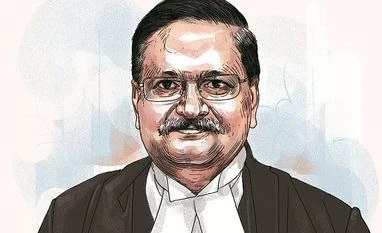
For retired Supreme Court judge and current chairperson of the National Company Law Appellate Tribunal (NCLAT), Justice Sudhansu Jyoti Mukhopadhaya, challenging the status quo is not an alien idea.
In 2013, he was part of the two-member bench that controversially recriminalised homosexuality, overturning a landmark Delhi High Court judgement. In upholding the notorious British-era section 377 of the Indian Penal Code, Mukhopadhaya, along with Justice G S Singhvi offered two remarkable reasons for doing so: that only a minuscule fraction of the country’s population constituted LGBTQ and that in more than 150 years, less than 200 people had been prosecuted.
That this ruling was given a decent burial by a larger bench under then Chief Justice Dipak Misra fie years later does not seem to have lessened Justice Mukhopadhaya’s penchant for original thinking. On July 4, he created a stir in NCLAT with his ruling in the Essar Steel case that financial and operational creditors of a company undergoing the Corporate Insolvency Resolution Process (CIRP) have equal rights, a judgement that appears to contradict basic commercial logic. Unsurprisingly, banks have appealed to the Supreme Court (the hearing is due July 22) but Mukhopadhaya’s ruling could be rendered moot with the Cabinet approving, on June 17, a critical amendment to the Insolvency and Bankruptcy Code that accords preference to secured lenders (that is, financial creditors) in the process.
For his part, Justice Mukhopadhaya remains unfazed by the flutter his ruling created among bankers and other lenders. Known to be a hard taskmaster, he presides over his court with energy and brio, questioning advocates, senior or junior, about the several intricacies of IBC as well as company law. Attempts by petitioners to delay the judicial process invite his special wrath. And though IBC hearings involve serious questions of law, Justice Mukhopadhaya leavens the atmosphere with quips and limericks. Jokes and puns on “haircut”, the term banks use to indicate the hit they take on their loan books, are often heard in his court.
Outside the court and after office hours, Justice Mukhopadhaya enjoys talking about the kitchen garden he maintains at his official residence in Lutyens' Delhi. At one such informal after-office meeting with journalists, he told reporter about his Bihar-Bengal roots and recalled how, as a judge in the Patna High Court, he had once initiated contempt proceedings against his own uncle.
“I do not see if someone is my uncle or relative. If they are wrong, they are wrong. I have even initiated action against my own staff at NCLAT for wrongly listing a case despite my orders against it,” he had then said.
“The good thing about Justice Mukhopadhaya is that he gives youngsters a chance to argue their case. If they know their facts, he does not brush them aside. It helps,” said a junior advocate. More often than not, he also stops junior advocates who use the wrong laws, quipping, “I am arguing for you. You please don’t”.
Like most judges, Justice Mukhopadhaya started his career as an advocate. He worked with the Patna and Ranchi Benches of the Patna High Court of Patna, starting in 1979. Fourteen years later, he was designated a senior advocate by the Patna High Court, where he continued to practice in constitutional, service, civil and criminal matters.
A year later in 1994, Justice Mukhopadhaya was appointed a permanent judge of the Patna High Court, and in 2002, when the Jharkhand High Court was formed, he was transferred. Having served as acting Chief Justice in the Jharkhand and Madras High Courts at various times, he was appointed the Chief Justice of Gujarat High Court in 2009. In 2011, he was elevated to the Supreme Court, where he presided till his retirement in 2015.
As NCLAT chair, lack of basic infrastructure remains Justice Mukhopadhaya’s biggest challenge. The lack of permanent staff to take down orders in shorthand and later type them out for him to correct is just one among many. In cases where there are a number of intervening parties and applicants, the courtroom is often so jam-packed that even the senior advocates have failed to find place inside.
At 69, with about seven months to go before his superannuation, Justice Mukhopadhaya often rues that he is racing against time to complete as many cases as he can. Giving “justice to the petitioner and being fair to all” has been his motto, he says. His legacy, though, may still lie in his two unusual rulings.

 "Lack of infra remains biggest challenge for NCLAT's Justice Mukhopadhaya")












