Oct manufacturing PMI signals gloom
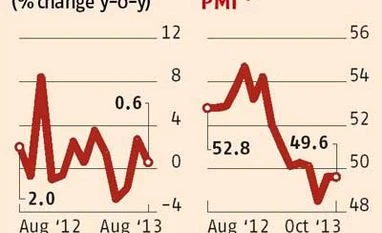
Unchanged from September's 49.6 points, sector deteriorated for a third straight month
BS Reporter New Delhi Manufacturing activity shrank in October, according to the widely-tracked HSBC Purchasing Managers’ Index (PMI).
The PMI manufacturing index was unchanged from September at 49.6 points, indicating a contraction in the sector; a reading above 50 points indicates growth. This is a third straight month of contraction in PMI manufacturing.
“Order flows remain weak, despite a bounce-back in export orders after two months of decline,” said Leif Eskesen, chief economist for India & Asean at HSBC.
The new data could dash hope of a revival in the economy from the second half of the financial year (the first half ended in September). Various sections of the government and even independent economists felt the economy would start reviving from the third quarter. The official core sector numbers were issued on Thursday and were in contrast to this, as the eight infrastructure sectors grew at a year’s high of eight per cent in September, hinting at an industrial recovery.
The decline in orders had picked up pace in September and as a result, manufacturers lowered their production volume in October, said Markit Economics, the financial agency which compiles the data. “Some firms indicated that Cyclone Phailin had also led to fewer new orders placed,” it said.
However, Markit said the export business expanded for the first time in three months during October.
“Anecdotal evidence suggested the weaker rupee had boosted foreign demand,” it said.
The official numbers were far stronger. These say export growth was in double digits in July-September and at a six month high of 11.5 per cent in September.
The good news was that consumer goods was the best performing among all sectors in October, said Markit, as production, new orders and exports rose in the segment. According to official data, the sector contracted by 1.6 per cent in April-August, mainly due to poor demand.
However, the October growth in consumer goods was offset by declines in intermediate and capital goods’ output.
Inflation continued to weigh heavy on manufacturers. Input cost inflation accelerated to a 16-month peak and selling prices rose at the fastest pace since February. As a result, the additional cost burdens were partly passed on.
“Saddled with additional costs, firms decided to lift output prices to protect margins. This suggests the Reserve Bank of India (RBI) has to continue its staring contest with inflation,” said Eskesen.
RBI had raised the repo rate by 25 basis points to 7.75 per cent in the second quarter monetary policy review this week, citing inflation as the main worry.
This could dash hopes of a expected revival in the economy from the second half of the year. Various sections of the government and even independent economists are of the view that the economy will start reviving from the third quarter.
The official core numbers released yesterday were in contrast to this as the eight infrastructure sectors grew at a year-high of 8% in September, hinting an industrial recovery according to the experts.

 "Oct manufacturing PMI signals gloom")


 Connect with us on WhatsApp