Finance Minister Arun Jaitley on Friday said public-sector banks had promised further transmission of the Reserve Bank of India's rate cuts, in coming weeks. These moves by lenders, when they happen, will mean lower monthly instalments on loans for customers.
"Some part of the rate cut has been passed on to customers but some banks have not yet passed on. Some bankers said they would be in a position to work out greater cuts over the next few weeks," Jaitley said at a press conference after his meeting with heads of public-sector banks.
Some banks, Jaitley said, had expressed inability to pass on the cuts because of problems with their respective balance sheets and higher rates on small savings schemes. However, "the environment is optimistic", he said.
"Both public-sector banks and private lenders basically expressed that until the cost of funds/deposits for banks, as reflected in the re-pricing of their liability book at the new rate, came down and liquidity levels at the new lower costs were tested, full transmission would not be viable. However, all banks unanimously expressed that in a period of two-three months, greater transmission of rate cuts could be seen," went a finance ministry statement released later in the day.
Many banks, including market leader State Bank of India, had lowered their interest rates after RBI reduced the repo (lending) rate by 25 basis points in its second bimonthly monetary policy review on June 2.
Since January, RBI Governor Raghuram Rajan has reduced the rate by a total of 75 basis points in three tranches.
Jaitley and other senior government officials, including Financial Services Secretary Hasmukh Adhia, took up a number of other issues with the bankers. Among those, problems of higher bad loans, the health of the economy, and stuck infrastructure projects, were discussed with heads of banks.
Jaitley told reporters Prime Minister Narendra Modi and the government's biggest priority on the economic front at present was getting stalled projects started. He said the department of financial services would now focus on the projects that were stalled due to financing issues.
"At the level of the secretary and, if necessary, my level, meetings of representatives of state governments, stuck projects and departments concerned will be called over the next few days. The idea will be to try and resolve the issues," the minister said.
The government, Jaitley said, would also consider favourably the demand of public-sector banks for more capital infusion, over and above what was earmarked in Budget 2015-16. The Centre has budgeted Rs 7,940 crore to recapitalise banks in the current financial year. RBI had earlier said the amount was inadequate and needed to be enhanced.
Jaitley said there was a "merit" in banks' request for greater capital infusion and the government would seriously look into that. The final decision to this effect would be taken by the Union Cabinet, he added.
As regards the non-performing assets (NPAs) of banks, Jaitley said the situation had improved in the January-March quarter but it was important to watch the developments over the next two-three quarters before reaching a conclusion.
"In the quarter ended March 2015, NPAs had come down from 5.64 per cent to 5.2 per cent. (But) one quarter does not indicate a pattern. So I would wait some more before deciding what the pattern is. Banks are themselves of the assessment that it would take two-three quarters for them to reach a somewhat greater comfort level," he said. The minister also expressed confidence that the NPA situation would improve with the government's greater spending thrust and a further pick-up in the economy.
Observing that the economy was recovering from the serious challenges it had faced in the past few years, Jaitley said: "We can take some satisfaction from the fact that even though international agencies are rating us as perhaps the fastest-growing among emerging economies, our own level of ambition is higher". He said the basic fiscal data looked good and the economy was on a road map for much higher growth.
"In terms of policy initiatives, and in terms of expediting the execution of stalled projects, the government will continue to play a very important role. Its spending in infrastructure has increased," he said.
"We did ask every bank with a high NPA level to explain the reason and groups on whose account defaults were higher. Over the next few months, this is something that the government is going to seriously look at," he said. Jaitley also said although retail credit had picked up, corporate credit was still to look up.
He added that two social-sector security schemes - Jan Suraksha Bima and Jeevan Jyoti Bima - had seen 101.7 million policies being sold in a month's time. "The initial participation of private-sector banks in these schemes had not been as much as public-sector ones. But today, after seeing the response, private-sector banks are saying they are also receiving interesting queries and are going to participate in a big way," the minister said.

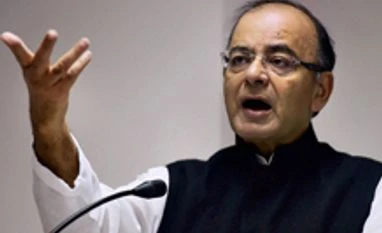 "More rate cuts likely from banks soon, says Jaitley")


 Connect with us on WhatsApp