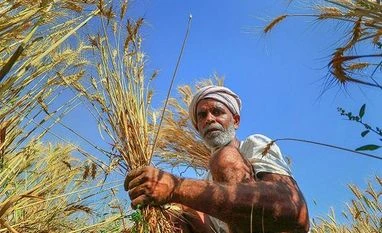
India on Wednesday raised the government-mandated price for summer-sown crops such as rice and cotton by the most since Prime Minister Narendra Modi came to power in 2014, as he looks to woo millions of poor farmers ahead of a general election next year.
"The government is committed to realising the vision of doubling farmers' income by 2022, towards which it is working on a comprehensive strategy," Radha Mohan Singh, the minister for agriculture and farmers' welfare, said in a statement after a meeting of Modi's cabinet.
Rural India voted overwhelmingly for Modi's Bharatiya Janata Party four years ago to hand him the biggest mandate in 30 years. But a crash in commodity prices has meant his immense popularity in the countryside has waned over the past few months.
The government, however, said on Wednesday the latest hike in the so-called minimum support prices (MSPs) would help farmers increase their income and boost the economy.
The total cost to the government would be Rs 150 billion ($2.18 billion), interior minister Rajnath Singh, himself a farmer, told reporters, adding that it would be wrong to say inflation would increase due to the hike.
Though the government announces MSPs for most crops, state agencies buy only rice and wheat at those prices given a lack of financial resources, limiting the benefit of higher crop prices to only 7 per cent of the country's farmers.
"Should the government rely on large-scale procurement of crops to implement these prices, then the fiscal cost could be around 0.3 percent of GDP (gross domestic product), which will likely be shared by the central and state governments," said A. Prasanna, chief economist at ICICI Securities Primary Dealership in Mumbai.
The government said prices paid to local farmers for common grade paddy rice will be raised by 13 per cent from a year ago to Rs 1,750 ($25.50) per 100 kg for the year starting on July 1. Last year, the government raised the rice price by 5.4 per cent.
"The impact from these MSP hikes will be 35 basis points to headline inflation in the current fiscal year, and another 35 bps in the next," said Shubhada Rao, chief economist at Yes Bank.
Analysts and economists have warned the move could prompt India's central bank to raise interest rates more steeply than expected.
Crop 2017/18 2018/19 Paddy rice (common) 1,550 1,750 Sorghum 1,700 2,430 Pearl Millet 1,425 1,950 Corn 1,425 1,700 Finger millet 1,900 2,897 Pigeon peas 5,450 5,675 Green gram 5,575 6,975 Black gram 5,400 5,600 Cotton (long staple) 4,320 5,450 Groundnut 4,450 4,890 Sunflower seed 4,100 5,388 Soybean 3,050 3,399 Sesamum seed 5,300 6,249 Niger seed 4,050 5,877 Prices are in rupees per 100 kg.