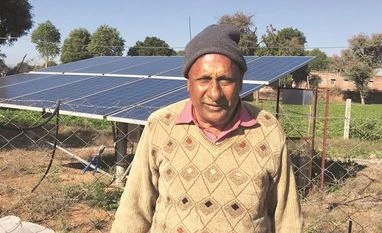
With a traditional turban wrapped around his head, Parbatilal Chotu Ram Jat typifies a stubborn old man who does not want to change. His angst against other communities which take the benefit of subsidies comes out in a rather strange way.
“Mei anodan se bach kar rahta hu. Jaivik khata ho aur kabhi bimar nahi padta (I keep away from subsidies. Eat organic and never fall ill),” Jat of Mehrauli Khatik in Rajasthan’s Sikar tells a group of officers from the horticulture department who are trying to convince him to use solar-powered pump that can irrigate his land without any of his family having to get up in the night. Also, saving on power bills.
He is ineligible for some benefits under the state government’s schemes because two of his sons are in government jobs, with the Central Industrial Security Force in Gujarat. However, this does not disqualify him from opting for solar-powered pump. Jat, who has one of his three sons helping him to farm, spends Rs 1,800 every two months on electricity for irrigation. He gets six-hour daily supply. His approach is in contrast to neighbour Shishupal Meena, who has built a polyhouse, a pond for collection of rainwater and has a 5 hp solar pump.
Further towards Jaipur on National Highway 11 is Udaipuria, where Hari Bhagwan Kumawat is very angry with the village’s lady patwari officer. “It is solar power (which I am asking for) and not her household electricity,” he rages as he points to a diesel tractor which energises a pump that waters his fields. The patwari needs to approve applications for solar power pumps and one of the conditions is that farmers should not have a grid connection or be running pumps on diesel.
Parbatilal Chotu Ram Jat does not want to change and use solar pumps
Naresh Pal Gangwar, principal secretary (horticulture) in the government of Rajasthan, underlines that to qualify for a solar power pump under Component B of the Centre’s KUSUM, a farmer should not have a grid connection for irrigation. “Nonetheless, farmers with a grid connection but who want to solarise can avail of government subsidy under Component C of KUSUM,” he adds. It is his department that is implementing Component B, under which they have to install an additional 25,000 pumps. A provision for Rs 257 crore in subsidy on this account has been made in the state budget. About 48,000 applications have been received via a portal the state government has set up. “We will be giving 25,000 connections on a first come, first serve basis,” says V Saravana Kumar, director (horticulture).
At Deroli Ahir village in Haryana’s Mahendragarh district, farmers used to pay Rs 80-150 to buy water for an hour. Some like Jaswant Singh earlier drew water from a traditional well but now use it only occasionally. “December and January are not very good for solar power generation. The plates do not generate power even in peak summer months when the temperature crosses 40 degrees Centigrade. Then, we depend on the earlier system,” says Singh.
Haryana, which is going to implement all three components of KUSUM, has raised the subsidy component for pumps. Against the notified 30 per cent subsidy each from the Centre and state under the scheme, Haryana alone will give 45 per cent subsidy.
Through an online portal, the state invited applications and got 15,354 requests. Manageable, considering it has approval for 15,000 pumps under Component B in the first phase. At the Mahendragarh district office, the number of applications is 819 against a target of 1,000 for 2019-20, not so enthusiastic a response. Drawing of ground water is not permissible in three blocks—Narnaul, Nizampur, Nangal Chaudhury— of eight in the district which is why the number of applications is less.
According to Kumar, the demand for 5-7.5 hp solar pumps is more in Rajasthan, since ground water levels are low. Pumps with a lower capacity of 3 hp can be used for pumping water only out of farm ponds. He, however, cautions that with six contractors finalised by EESL, implementation could be slower compared to what they were doing earlier with more than 20 contractors.
According to a Union ministry official, around 20 bidders participated in the EESL tender. Interest was expressed by 31 but six were disqualified and of the rest, some did not put in financial bids. The bidders have chosen among five zones; rates were higher for the northeast and hilly ones. Despite the delay in finalisation of the tender, states are waiting with farmer applications to start KUSUM.
Tomorrow: Fields without water, hope

 "No sunny days in sight: Challenges for solar pumps in Haryana, Rajasthan")












