Nothing short of stimulus: Fuel tax cuts may boost consumption by Rs 35K-cr

With revenues set to exceed the annual target by Rs 2 trillion, a softer revenue loss that boosts consumption will provide immense relief, especially to lower income households

Petrol price
The cut of Rs 5 per litre on petrol and Rs 10 per litre on diesel will provide relief to millions of Indian consumers
Abhishek Waghmare Pune
2 min read Last Updated : Nov 04 2021 | 11:05 PM IST
After nearly 18 months, the Union government decided to reduce the exorbitant rates of tax on petrol and diesel. The cut of Rs 5 per litre on petrol and Rs 10 per litre on diesel will provide relief to millions of Indian consumers.

But as with any tax cut, this will hit the government’s treasury. But by how much?

A Business Standard analysis shows that the Centre will lose close to Rs 35,000 crore from the decision. Sounds like a big loss to the exchequer, but this amount will remain in the consumers’ pockets for consumption in the remaining part of the financial year. In other words, an amount worth nearly 0.15 per cent of gross domestic product will be available to Indians for private consumption for five months. This is nothing less than a stimulus to spend.

While this would have added 0.15 per cent of GDP to the fiscal deficit ceteris paribus, revenue from primary streams is so strong this year, that fiscal slippage would be the least of the Centre’s worries this year.


The Centre has garnered 55 per cent of its annual receipts in the first six months of 2021-22, against the usual average of 40 per cent in the first half. Further, the growth over FY20 (two years) has been strong at 31 per cent, falling in line with the average annual revenue growth of 14 per cent in normal times. Growth in tax revenues is stronger: 60 per cent has been covered half way through.

Economists have predicted excess revenue this year. Rating agency ICRA’s Aditi Nayar expects that the Centre’s coffers will welcome Rs 1.9 trillion of revenues over and above the budgeted numbers. Even if the fuel tax cut snips Rs 35,000 crore from Centre’s clutches, Centre’s revenue position is set to remain strong.

Some agencies have put a higher number on revenue loss. Nomura, for instance, believes that the revenue loss for the remaining part of FY22 will be Rs 45,000 crore.

“We revise our estimate of the fiscal deficit to 6.5% of GDP (previously 6.2%) versus the budget target of 6.8%,” it said in a note.

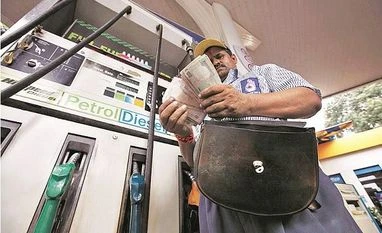
Reduction in fuel prices at the retail level will also ease inflation to some extent. After all, transportation is a cost borne by the masses, and inflation in the segment has been the highest in a decade.

“The tax cuts should lower headline CPI inflation by 0.14 percentage points due to direct effects, and up to 0.3 percentage points, if indirect effects are included,” Nomura added.   

This is how the calculation on potential loss to exchequer has been done. The Centre has earned revenue at the older (higher) rates for 7 months of this financial year. Nearly 40-42 per cent of petrol and diesel are consumed in the last five months of the year on average, a quick look at consumption of petrol and diesel in previous years tells us.  

The government expected Rs 3.2 trillion this year from the two fuels, according to the Union Budget 2021-22. Probable revenue from the last five months has been calculated using the share mentioned above.

Further, petrol occupies nearly 30 per cent share in total consumption of the two most commonly used retail fuels. This share, or weight, has been used to arrive at the estimate of revenue lost.

The Centre and states together have pocketed close to Rs 7 trillion (nearly 3 per cent of GDP) just from levying tax on the two fuels since rates were raised after the pandemic began.

After the Centre's decision to cut fuel taxes, it is likely that some states will follow suit and reduce sales tax (or value added tax) on the fuels. Some states like Tamil Nadu (reduced VAT by Rs 3 per litre) have already taken the step.

But it is equally likely that states might maintain the status quo. Unlike the Centre, which raised taxes heavily in the form of cess and gained much more than states, states’ earnings from fuels have remained steady at Rs 2 trillion annually for three years.

One subscription. Two world-class reads.

Already subscribed? Log in

Subscribe to read the full story →
*Subscribe to Business Standard digital and get complimentary access to The New York Times

Smart Quarterly

₹900

3 Months

₹300/Month

SAVE 25%

Smart Essential

₹2,700

1 Year

₹225/Month

SAVE 46%
*Complimentary New York Times access for the 2nd year will be given after 12 months

Super Saver

₹3,900

2 Years

₹162/Month

Subscribe

Renews automatically, cancel anytime

Here’s what’s included in our digital subscription plans

Exclusive premium stories online

  • Over 30 premium stories daily, handpicked by our editors

Complimentary Access to The New York Times

  • News, Games, Cooking, Audio, Wirecutter & The Athletic

Business Standard Epaper

  • Digital replica of our daily newspaper — with options to read, save, and share

Curated Newsletters

  • Insights on markets, finance, politics, tech, and more delivered to your inbox

Market Analysis & Investment Insights

  • In-depth market analysis & insights with access to The Smart Investor

Archives

  • Repository of articles and publications dating back to 1997

Ad-free Reading

  • Uninterrupted reading experience with no advertisements

Seamless Access Across All Devices

  • Access Business Standard across devices — mobile, tablet, or PC, via web or app

Topics :Fuel pricespetroldiesel pricedieselPetrol-diesel pricesFuel

Next Story





