Off the shelf: Plagued by sectoral issues, stuck projects still govt's sticking point
Some 125-175 projects have been scrapped because these were no more viable & did not have adequate back-end tie-up of raw material
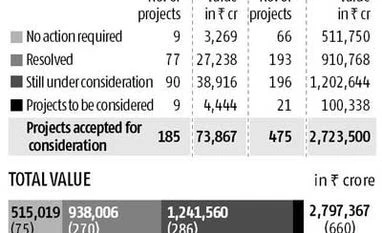
Jyoti Mukul New Delhi Earlier this month, a Union government assessment of troubled projects showed some 18 per cent of Rs 28 lakh crore worth of stalled projects put up to the project monitoring group (PMG) did not require any action from the government. There were 75 such projects, which together had 558 unresolved issues. It was, however, realised that despite making it to the list of some 660 projects accepted by PMG, the sticking points in these projects were beyond the domain of the government.
Some 125-175 projects have been junked or dropped completely because these were no more viable and did not have adequate back-end tie-up of raw material, says Vinayak Chatterjee, chairman, Feedback Infrastructure.
Officials said some of the project promoters were actually looking for concessions and financing, which was not within the scope of PMG. There wasn't any government scheme under which such facility could be provided. Problems of some 41 per cent of the projects put up to PMG and comprising 34 per cent of the project cost are considered officially resolved. It might, however, not be necessary that projects, which are considered resolved, may have picked up and come out of the stalled list.
In the power sector, for instance, issues in almost 22 projects are considered resolved, but of them, some 20 are facing trouble with power purchase agreements. "Clearances do not matter if a sector, as a whole, is in trouble due to macroeconomic or structural issues. In the case of power sector, there are issues relating to power purchase agreements. States are not coming out with enough number of bids to purchase power since their distribution companies are in losses so even though there is a demand, it is not materialising into purchases," said a senior government official.
Similarly, in the road sector too, operators want to exit projects irrespective of clearances since their balance sheets are over-leveraged in most cases, the official said. "The problem relating to clearances is not insurmountable but a project is much bigger than government clearances. It has its own financials and market."
Nevertheless, 630 projects worth Rs 27 lakh crore are being processed by various sub-groups in the PMG. Some 185 projects of these worth Rs 73,867 crore involve investment of less than Rs 1,000 crore. This number was quiet small in 2013, when few months after PMG was set up, only 17 projects less than Rs 1,000 crore in value were being considered. The focus was more on big projects.
Chatterjee agreed that clearances were just one set of problems for a project. Stalled projects can be classified into various buckets - ones stuck because of issues related to clearances, sectoral issues, where promoters have stretched themselves, and the sick or dead projects. "Problems of projects in each of these buckets need to be handled differently," he says.
The Rs 40,000-crore Tilaiya ultra mega power project of Reliance Power still figures on the list of stalled projects even though the company announced exiting the project through termination of 18 power purchase agreements with state governments in April 2015.
Similar is the case with the expansion of the Rs 1,158-crore Adhunik Alloys & Power plant in Jharkhand where the promoter was asked to make an upfront payment amounting to 80 per cent of the land cost for 86.43 acre that had been acquired. But according to the Jharkhand government, the project promoter did not respond to the payment request and so the project was dropped out of the government's stalled project list.
There seems to be a near unanimity among industry, government and experts that unless sectoral and demand issues in various infrastructure segments do not phase out, resolution of issues concerning 41 per cent of projects amounting to 33.5 per cent of value would not make the desired impact.

 "Off the shelf: Plagued by sectoral issues, stuck projects still govt's sticking point")


 Connect with us on WhatsApp