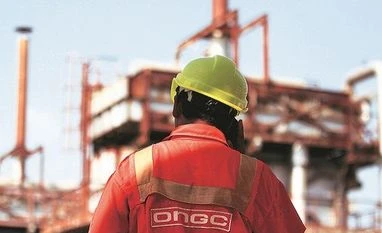
State-run Oil and Natural Gas Corporation (ONGC) and Oil India (OIL) may gain rights to choose their partners by auctioning select blocks to private players as part of the government’s production enhancement policy. However, ONGC’s resistance to the inclusion of Bassein, India’s largest gas field, remains a hurdle.
A high-level committee comprising officials from the Directorate General of Hydrocarbons (DGH) and the petroleum ministry is set to meet ONGC and OIL executives later this week to resolve differences.
The production enhancement policy is part of a strategy by the government to bring down crude oil imports by 10 per cent by 2022.
The DGH had identified blocks for farming out a 60 per cent stake in 15 fields. However, the regulator has now zeroed in on seven fields — five of ONGC and two of OIL.
More than 40 fields of the state-run producers have been identified for production enhancement through the technical services model and also for farming out to private players. Those who bring in technology will get the tariffs they bid for in return for increasing output.
Discovered in 1976, the Bassein field is located 80 km off the Mumbai Coast in the Arabian Sea. Of the total 393 billion cubic metres (bcm) of initial gas in the field, ONGC has produced about 248 bcm.
The Association of Scientific and Technical Officers (ASTO) of ONGC had written to Prime Minister Narendra Modi in November last year against the move to privatise the blocks.
The production enhancement policy will have two options — one will be to give a stake to private players, and the other to assign service providers so that production can be increased from these fields.
“The major point of difference was regarding who would choose the partner and how many blocks would be privatised. Now, at this stage, the inclusion of the Bassein field is the point of contention. On the other hand, the companies may get the option to find their partner through a competitive bidding process,” said an official close to development.
ONGC is planning to invest over $11 billion in the next four years to increase its production by 30 per cent.
The NHPS has been rolled out in response to the need that a large chunk of India’s citizens has poor access to health cover. “The health of its population is central to a nation’s well-being and productivity. While India has made some significant gains in improving life expectancy and reducing infant and maternal mortality, our rates of improvement have been inadequate as a nation,” the Niti Aayog noted at the launch of its health outcomes scored by the states.
Among their other concerns, the insurance companies have argued that there should be a common technology platform to ensure standardisation of all claims and premium payment. “An Aadhaar-based biometric scan should be compulsory for hospitalisation. The will eliminate all impersonation-related frauds,” the insurance companies noted.
ONGC spread
335 nomination petroleum mining leases with an area of 56,675 sq km as on April 1, 2017
9 nomination exploration licences with an area of 37,764 sq km; has 32 active NELP blocks
4 NELP blocks in Gujarat have been converted, wholly or partly, into PML
948,643 sq km is NELP operating acreage area of ONGC as operator
6 NELP blocks where ONGC is a consortium partner
9,655.36 million tonnes (mt) is the total in-place reserves of ONGC as on April 1, 2017, against 9,444.74 mt a year earlier