The vagaries of onion prices have again sprung a nasty surprise on Maharashtra’s farmers.
In a seasonally lean period, when prices have typically been on the higher side, onion prices this year crashed to Rs 1-1.50 a kg in the Lasalgaon market. At this price, farmers said they can just about cover the cost of transportation.
“It is better to run a tractor and plough the land on which onions have been planted, as the cost of harvesting and transportation are much higher than the realisations,” said Madhukar Bhagwat, who dumped his produce at the Lasalgaon mandi as his wait for buyers turned fruitless.
Deepak Pawar, a farmer from Niphad village in Nashik district, said: “Banks have sent notices to us for recovering loans. As our selling prices has fallen hugely, we will not be able to pay.” Pawar has harvested 5.5 tonnes of onion on his 1.5-acre farm. Rock-bottom prices have pushed farmers to the wall in India’s largest onion market. On Saturday, hundreds of farmers had gathered in front of the collector's office in Nashik in support of Popat Ushir, who has been on a hunger strike for six days and has promised to continue the fast until death if the government does not agree to his demands, the main one being a subsidy of Rs 5 a kg.
Ushir produced 20 tonnes of onion this year. He was lured by the attractive prices of last year and brought his entire landholding under onion this year.
Atul Shah, director, Agricultural Produce Market Committee-Pimpalgaon, said, “Onion prices are unlikely to recover anytime soon due to weak demand. Exporters have remained absent from the market, resulting in an abundance of supply. More so, the new season’s supply has started from Bengaluru. So supply is going to intensify in the coming days.”
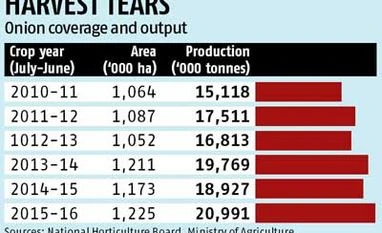
A year ago, the situation was different. Onions were trading at Rs 40-44 a kg in the country’s largest onion market, near Nashik, because of a supply shortage caused by two continuous years of drought. Consumers were at the receiving end, as prices had ruled at Rs 55-60 a kg in the retail market. As a result, most farmers brought a larger area under onion this year.
At current prices, farmers have fallen deeper in debt as they have been unable to cover costs such as inputs, sowing, replanting, weeding and irrigation, among others.
Typically, the period between June and September is a lean season, and a period for farmers and stockists to mint money by controlling supply to raise prices. In June, prices were Rs 7-8 a kg. The government, which was taking measures to ensure availability, had imposed a minimum export price of $700 a tonne a year ago. It is now looking to subsidise exports. The government has already announced a production subsidy of Rs 1 a kg, which farmers claim is insufficient to cover losses.
Hansraj Patil, regional president of Swabhimani Shetkari Sanghatana, a farmers’ association that has fought for fair prices for cultivators, said: “Rising seed and fertiliser prices, along with a sharp increase in labour and transportation costs, have escalated production cost to Rs 5-6 a kg. Against that, our realisation currently stands at Rs 2-2.5 a kg, including the Rs 1 a kg subsidy. So, this negligible subsidy of Rs 1 is insufficient. Therefore, the government should bear the entire loss and raise subsidy immediately to at least Rs 5 a kg.”
Ushir has urged the government to set up an onion board, on the lines of the Tea Board and the Coffee Board, with active participation from farmers. He has also asked the government to fix the onion minimum support price at Rs 15 a kg. In case prices fall below this level, the government should compensate the difference directly to farmers' accounts. “We have received a letter from the district collector’s office assuring us that they have informed the Maharashtra government of the problem, and have requested me to end the hunger strike. The ministry official concerned has verbally assured us that they are looking into our demands. But we want a written assurance from the government about a lifetime solution to farmers’ problems,” said Ushir.
Apart from Rs 5 a kg subsidy, Ushir has demanded the government compensate the losses that farmers incurred during the 35-day market strike in July-August. A substantial part of the rabi crop, stored under cover in the fields, was spoilt. Farmers want the government to submit a report after ascertaining the losses and provide compensation.
Boosted by an increase in acreage, India's onion output was estimated at 21 million tonnes this year, against 19 million tonnes last year. “The fall in price is unlikely to deter farmers from dramatically reducing the sowing acreage next season, as they expect a recovery then,” Shah said.

 "Onion price collapse make farmers see red")


 Connect with us on WhatsApp