Ordinance to increase luxury car cess to 25% likely this week
The move adversely impacts Mahindra & Mahindra, Toyota, and luxury carmakers such as Mercedes, BMW
Arup Roychoudhury New Delhi The Narendra Modi government is likely to promulgate an ordinance as early as this week to increase ceiling on cess to 25 per cent from the present 15 per cent over the peak rate of 28 per cent goods and services tax (GST) on luxury cars and sports utility vehicles (SUVs).
The ordinance will amend the Schedule to Section 8 of the GST (Compensation to States) Act, 2017, for the cess to be increased. Business Standard has learnt from senior government officials that the ordinance has been drafted and has been checked by Finance Minister Arun Jaitley’s office.
It is expected to be available for President Ram Nath Kovind’s consideration very soon, said an official. This could happen as early as the current week. The ordinance has to be then ratified by Parliament in the upcoming winter session.
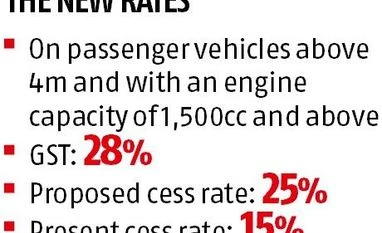
Earlier this month, the GST Council had recommended an amendment to increase the cess on all passenger vehicles above four metres and with an engine capacity of 1,500cc and above to a peak of 25 per cent. Such vehicles currently attract GST of 28 per cent, and a 15 per cent cess. Even after the ordinance, the increase in cess would be finalised by the GST Council and total tax and cess may not go beyond 50 per cent.
The move adversely impacts Mahindra & Mahindra, Toyota, and luxury carmakers such as Mercedes, BMW, Audi and JLR. The decision has upset the growth plans of the luxury car industry, which had seen a flat performance in 2016, owing to demonetisation and the ban on 2,000cc diesel cars in the National Capital Region for the first eight months of the year. The decision to increase the cess was taken after the Council found the taxes on these cars were lower under the GST regime than the indirect taxation system.
Earlier, the Council had also raised the cess on cigarettes when it was found that the rates under the GST system were lower than the older taxation system of excise duty and state-level value-added tax.
Prices of most such vehicles had turned significantly cheaper in most states following the introduction of the GST on July 1. Toyota’s Fortuner had turned cheaper by Rs 2.17 lakh and the Innova by Rs 1 lakh. Most luxury cars had also turned cheaper by as much as 8-10 per cent in many states.

 "Ordinance to increase luxury car cess to 25% likely this week")


 Connect with us on WhatsApp