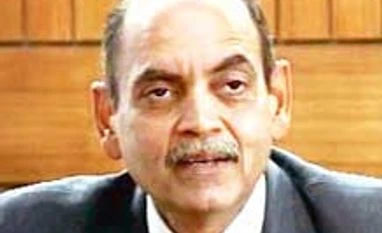
Our laws give the ability to bite but we need to do it before things blow up: Rajiv Takru
Interview with Financial services secretary
Vrishti Beniwal New Delhi Multiple government agencies got into action after the Saradha financing scheme scam in Bengal hit the headlines.
Rajiv Takru, secretary of the Department of Financial Services, says it is high time government organisations worked together to take an account of their individual actions. In an interview with Vrishti Beniwal, he also speaks on new bank licences, the asset quality of banks and the debate over Life Insurance Corporation (LIC)’s equity exposure cap. Edited excerpts:
Soon after taking charge, you had to deal with the Cobrapost exposure on alleged money laundering by three private sector banks and you’re now looking into the Saradha scam. Is there a need to address the problem at a larger level, rather than in a piecemeal fashion? There are two ways of looking at these things. One, that both events individually point at some systematic defects. The other is that these events also point at certain things that are wrong or could be wrong in the organisation, per se. The final truth is yet to be established in both cases. The Cobrapost expose was followed by an RBI (Reserve Bank of India) audit. Now, the RBI report has come and the banks concerned have been told what was discovered and asked to respond. They have also been asked to rectify things within their banks. Saradha is a different kind of case. The enforcement directorate, SFIO (Serious Fraud Investigation Office), state government and RBI are involved. We still don’t know the final picture.
What measures are you taking to prevent such cases? We are addressing the systemic issues and these are being discussed, both with the banks and RBI. I had a meeting with the senior management of public and private sector banks. Whatever needs to be done — either in terms of punitive action or action against individual staff members or action against an institution or changes in the oversight mechanism and incentive policies of the banks concerned or the general system parameters which allow such things to go on without the regulator being able to catch them — will be done. We must have institutional safeguards. One thing we noticed is that as so many agencies are involved and all of them operate differently, sometimes, these bodies (let some things) slip through the chinks in the system. There is definitely a need for better administrative coordination. An inter-ministerial monitoring body would be meeting on a monthly basis to address the issue.
Besides better coordination, do we need a change in laws?
I’m not saying no change in the law is required. The Sebi (Securities and Exchange Board of India) chairman has said certain changes are in the offing. If agencies think they need more teeth, we have no problem with that. As far as the RBI Act is concerned, I don’t think we require any additions to that. Teeth are there, the ability to bite has been given by the law but I actually need to bite. We need to apply the law and that’s what we are discussing with RBI, that they can get a little proactive here and take action before this whole thing blows up. It’s only after something happens that we get active. We need to change the method of implementation.
When is RBI expected to issue new bank licences?
In the time frame they’d specified, applications for licences were supposed to come by June 30. After the guidelines came, a huge number of queries were received by RBI. The creator normally does not see something which might not be clear to the other side.
RBI is clarifying these and in the remaining two months, we expect to see a large number of applications come in. After that, an internal committee of RBI will examine these. Then, there will be an external committee, which would do due-diligence and, then, it would go to the approving body at a higher level in RBI. I expect to see licences issued within this financial year, certainly.
Would the licences be issued in a bunch or one by one?
That’s depends on how RBI wants to do it. Strategically and tactically, it would be a better idea to see how many people are satisfying the due-diligence (checks) and then work backwards from the requirements of the economy, to see how many of these could be adjusted in how many branches, to cover as much of the economy as possible. We are horribly under-serviced in banking and insurance. There is a huge scope for new bank branches.
Parliament’s standing committee on finance has expressed concern on giving recapitalisation support to banks at a time when the fiscal deficit is high.
I completely agree with them. We are setting up a financial holding company. Inter-ministerial consultation is going on and I think it should be over in a month or so. If the holding company is set up this year, it will raise money from the market and provide it to the banks, relieving the government of that burden. In any case, capital infusion is always done towards the end of the year.
Huge non-performing assets (NPAs) of banks are a cause of concern. The finance minister had asked banks to recover the dues from rich promoters of affluent companies but the progress seems slow.
Banks are reducing gross (non-performing assets) NPAs but it takes some time. They are going after wilful defaulters and recoveries are being made. If personal guarantees have to invoked, they will be.
What is the progress on setting up of the Women’s Bank?
The expert committee set up under M B N Rao gave its report on April 30. We had a detailed discussion with them. They have given us an action plan, which seems workable. We are now working out our timelines. As of now, we stick to the deadline of November for the launch.
It appears not many are interested in heading the bank, as it will have only six branches.
I’m little surprised to hear that because we have not asked anybody yet to head it. I think this bank has a future. I can assure you it’s not going to suffer because of lack of leadership.
The equity exposure cap of LIC (Life Insurance Corp) has become a matter of debate.
Irda (Insurance Regulatory and Development Authority) has an opinion, the government had an opinion. We discussed it with them. They have a board meeting coming up. The issue is being looked at. It will be, hopefully, resolved very soon.
Would you like to retain it at 30 per cent or bring down?
If I give a number, I tend to put a stake in the ground. I don’t have a stake in it. There are different views. We can arrive at something both of us are comfortable with.
Direct benefits transfer has not picked up well. What are the issues, besides Aadhaar seeding?
Aadhaar can never be the reason because the government de-linked transfer of benefits from the Aadhaar right from the first day. Initially, there were teething problems. We are going ahead on a very fast track on the matter of procuring micro ATMs (automated teller mchines) and training banking correspondents. I’m having a meeting with executive directors of banks and the Indian Banks’ Association on May 8 in Mumbai. I’m pretty optimistic that by June, this activity should be over.

 "Our laws give the ability to bite but we need to do it before things blow up: Rajiv Takru")


