PMO push to flying rights auction plan

Indian airlines oppose proposal as state-owned Gulf airlines would have unfair advantage
Aviation
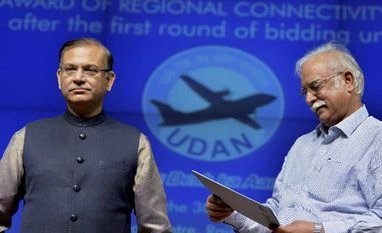
Civil Aviation Minister Ashok Gajapati Raju and Minister of State Jayant Sinha at a press conference in New Delhi (Photo: PTI)
Arindam Majumder New Delhi
Last Updated : Apr 03 2017 | 12:28 AM IST
The government is yet again contemplating a plan to auction bilateral flying rights to international destinations within a 5,000-km radius of New Delhi. 

The idea was first mooted last year when the National Civil Aviation Policy was being framed; it was later referred to the Committee of Secretaries. It was put on the backburner earlier, after domestic airlines protested against it. 

However, now the Prime Minister’s Office (PMO) is said to be pushing for it. If the plan sees the light of day, airlines from the Persian Gulf, such as Emirates, Etihad, and Qatar Airways, would have to bid for flying rights — the number of seats or flights — to India. These airlines are already expanding operations in the country and are looking to increase their seat-share entitlements. 

At present, countries sign air service agreements with Indian authorities to decide how many flights or seats they can offer for their operations in the country. The seat entitlement can be increased if a particular airline exhausts the limit.

Though the rules for the bilateral auctioning process have not been firmed up, it could work somewhat like this: The Indian authorities would auction the total number of seats allotted to each country, and airlines — both from that nation and from India — would bid for it. Top officials in the aviation ministry said last week, following directions from the PMO, the Cabinet secretariat had called the chief executives of domestic airlines and top ministry officials to discuss the matter. 

“The push seems to have come from the very top,” said a source, adding that after the successful auctioning of the telecom spectrum, the PMO asked the aviation ministry to consider this project. At the meeting, all major private airlines and government-owned Air India opposed the idea of bilateral auctioning. They said such a policy did not exist anywhere in the world and it would be detrimental to the sector.

The Indian airlines said the Gulf hubs, which are within the 5,000-km distance limit, operated as city states, with only one designated airline each. So, in the auction process, which requires competitive bids, there would not be any competition.

“An Emirates or a Qatar are the only airlines of their respective states. Who will compete in the auction process with these airlines? Indian airlines are not in a position to compete financially, as the Gulf airlines, backed by their governments, have deep pockets,” said a senior executive of a private Indian airline. He added the Gulf airlines operated mostly on international routes, as there was no scope for domestic operations in these city states. 

Indian airlines were also asked if they would like to sell their unused seat entitlements rather than not utilising these. “This idea was also opposed, as bilateral rights being sovereign rights are not purposed to generate transaction value. Also, unlike before, the Indian airlines now utilise their full share of seat entitlements to the Gulf countries,” the executive said.

According to the Convention on International Civil Aviation, also known as the Chicago Convention, signed in 1944 and subsequently revised a number of times, all nations have complete sovereignty over their air space. These nations can set their own rules for air traffic rights. These may be bilateral open skies with select nations or bilateral agreements. 

Last year, India decided to enter into an open-skies agreement with South Asian Association for Regional Cooperation countries, and with those beyond the 5,000-km radius of New Delhi.

Back on the runway
 
The government is yet again mulling auctioning bilateral flying rights 

  • Proposal: Auction of flying rights — number of seats or flights — to destination within a 5,000-km radius of New Delhi, mostly hubs in the Persian Gulf
  • Rules: According to the Chicago Convention, 1944, all nations have complete sovereignty over their air space and can set their own rules for air traffic right, such as open skies or bilateral agreements 
  • Hurdle:  Indian airlines oppose the proposal. They claim Gulf airlines, backed by their respective governments, would have an undue advantage. Also such a policy is not followed anywhere in the world

One subscription. Two world-class reads.

Already subscribed? Log in

Subscribe to read the full story →
*Subscribe to Business Standard digital and get complimentary access to The New York Times

Smart Quarterly

₹900

3 Months

₹300/Month

SAVE 25%

Smart Essential

₹2,700

1 Year

₹225/Month

SAVE 46%
*Complimentary New York Times access for the 2nd year will be given after 12 months

Super Saver

₹3,900

2 Years

₹162/Month

Subscribe

Renews automatically, cancel anytime

Here’s what’s included in our digital subscription plans

Exclusive premium stories online

  • Over 30 premium stories daily, handpicked by our editors

Complimentary Access to The New York Times

  • News, Games, Cooking, Audio, Wirecutter & The Athletic

Business Standard Epaper

  • Digital replica of our daily newspaper — with options to read, save, and share

Curated Newsletters

  • Insights on markets, finance, politics, tech, and more delivered to your inbox

Market Analysis & Investment Insights

  • In-depth market analysis & insights with access to The Smart Investor

Archives

  • Repository of articles and publications dating back to 1997

Ad-free Reading

  • Uninterrupted reading experience with no advertisements

Seamless Access Across All Devices

  • Access Business Standard across devices — mobile, tablet, or PC, via web or app

Next Story



