Putting an end to a 92-year-old tradition of the colonial era, the railway Budget will be merged with the general Budget from 2017-18 onwards.
The move will come as a relief to the national transporter, which, until now, has been reeling under an additional burden of Rs 40,000 crore from higher salaries, following implementation of the 7th Pay Commission. It also has to bear close to Rs Rs 35,000 crore of subsidy burden. If the merger goes through, the Railways will get rid of the annual dividend it has to pay for gross budgetary support from the government.
Ashok Lavasa, finance secretary, told Business Standard, a five-member joint committee has been constituted with joint secretary in-charge of the Union Budget in the ministry of finance coordinating the functioning. "The committee will go into what is required for merging the two Budgets. It will submit its report for consideration within a month," he said. When contacted, a senior railway official said the Railways, too, was keen on the merger.
The Union finance ministry has its given a go-ahead to the proposal and set up a five-member committee, confirmed a railway official. When contacted, another railway official said, “The Railways is keen on the merger. However, there has been no official confirmation from the finance ministry as yet.”
Currently, the Indian Railways suffers from a massive revenue deficit; the burden of which will be transferred to the finance ministry after the merger.
The idea was recently mooted by a committee headed by NITI Aayog member Bibek Debroy, as part of the restructuring of the Railways. “The Railways has structural problems. It needs rapid modernisation and reforms. The government is taking steps towards that now,” Debroy told Business Standard last week.
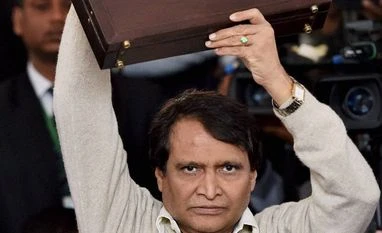
The largest employer in the country with the largest rail network in the world now accounts for a meagre 15 per cent of the total Union Budget. Responding to a question in the Rajya Sabha, Rail Minister Suresh Prabhu said, “I have written a letter to the finance minister, saying we are willing to merge. In fact, I had suggested the same last year. It’s not as if I want to present a Budget; I am looking at the larger national interest. The merger should happen in a way the Railways becomes a part of the overall Budget, and the capital expenditure, revenue deficit, etc, can be taken care of,” he said.
According to Prabhu, the Railways was overburdened with Rs 60,000 crore worth of public service obligation. He added the Indian Railways has the potential to contribute around 2-2.5 per cent of the gross domestic product but it needs investment. The rate of dividend of Railways for 2015-16 was four per cent, compared to five per cent in 2014-15.
The rail Budget was separated from the main Budget, following recommendation of a panel headed by British railway economist William Acworth in 1920-21. Every year, the rail Budget is presented in Parliament a few days ahead of the general Budget.
The rail Budget has had a separate existence from the general Budget since 1924 when the British spun it off for a better focus on India’s most important infrastructure network. The Railways then accounted for 70 per cent of the total Budget.
Off the rails
Since many politicians use the railway Budget to improve their vote bank, the national transporter is now facing a paucity of funds for expansion and replacement of worn-out tracks.
The merger may transform the Railways to just another government department, as it may lose its commercial character. Through the merger, the railway revenue as well as expenditure will also become a part of the general revenue. It needs to be seen the strategy of the finance ministry would be, in case of revenue shortfall. Moreover, the finance ministry will also have to suffer the constraints on raising passenger fares, as it is not considered a populist move. This may also slow the pace of privatisation plans of the Railways.
CHALLENGES AHEAD
The move will come as a relief to the national transporter, which, until now, has been reeling under an additional burden of Rs 40,000 crore from higher salaries, following implementation of the 7th Pay Commission
The idea was recently mooted by a committee headed by NITI Aayog member Bibek Debroy, as part of the restructuring of the Railways
The rail Budget was separated from the main Budget, following recommendation of a panel headed by British railway economist William Acworth in 1920-21
The largest employer in the country with the largest rail network in the world now accounts for a meagre 15 per cent of the total Union Budget

 "Rail Budget's 92-year-old journey set to end")

