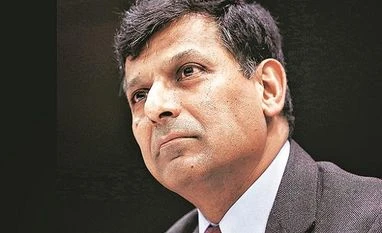
Former Reserve Bank of India Governor Raghuram Rajan said that the central bank will have to increase the headline rate at some point. "With inflation soaring in the country, the Reserve Bank of India (RBI) will, at some point in time, have to raise benchmark interest rates, and it is important for politicians and bureaucrats to understand that the rise in policy rates is not some anti-national activity benefiting foreign investors, but is an investment in economic stability, said Raghuram Rajan, former RBI governor.
In March, headline inflation in the country spiked to 6.95 per cent compared with 6.07 per cent in February. The headline inflation has now breached the 6 per cent mark for three consecutive months. In the recently concluded monetary policy meet, the RBI sharply revised its inflation projection from 4.5 per cent to 5.7 per cent for FY23. Further, the headline inflation is expected to stay above 6 per cent in the first quarter of FY22, as per RBI’s projections. And, for the June-September period, the CPI inflation rate is projected at 5.8 per cent. Consequently, economists have forecast aggressive rate hikes in the next one year.
“Of course, no one is happy when rates have to be raised”, Rajan said in his note. “I still get brickbats from politically-motivated critics who allege the RBI held back the economy during my term. Some of my predecessors were similarly criticized. At such times, it helps to let the facts talk. And the correct facts are important to guide future policy. It is essential that the RBI does what it needs to, and the broader polity gives it the latitude to do so”, he added.
Rajan recalled that when he took over as the governor of RBI in September 2013, India was seeing inflation soar as high as 9.5 per cent. There was a currency crisis too, with the rupee experiencing a free fall. Consequently, the RBI then increased the repo rate from 7.25 per cent in September 2013 to 8 per cent to tame inflation. As inflation came down, the RBI then cut rates by 150 basis points to 6.5 per cent and signed onto an inflation targeting framework with the government.
“These actions not only helped stabilize the economy and the rupee, they also enhanced growth”, Rajan said. “Between August 2013 and August 2016, inflation came down from 9.5 per cent to 5.3 per cent. Growth picked up from 5.91 per cent in June-August 2013 to 9.31 per cent in June - August 2016. The rupee depreciated only mildly over 3 years from 63.2 to 66.9 to the dollar. Our foreign exchange reserves rose from US $ 275 billion in September 2013 to US $ 371 billion in September 2016”, he added.
The RBI has since maintained low inflation and low interest rates through troubling times like the demonetization, the fall-off in growth, and the pandemic. Today, reserves have climbed to over $ 600 billion, allowing the RBI to calm financial markets even as oil prices have climbed, Rajan said.

 "Raising policy rates is not anti-national, RBI will have to do it: Rajan")












