Rice production in 2014 pegged at 88 million tonnes
Sowing area rises to 37.48 million hectares from 37.42 mn hectares in 2013
BS Reporter New Delhi As the four-month southwest monsoon season comes to an end on Tuesday, sowing of major kharif crops has picked up pace with the total area crossing 100 million hectares in 2014, a tad lower than last year's 104 million hectares.
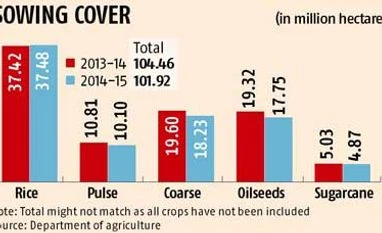
Area under rice, the main foodgrain grown during the kharif season, was estimated at 37.48 million hectares, more than 37.42 million hectares in 2013, when India received normal rains. According to officials in the know, the incremental rise in paddy area is because of basmati planting.
Rice production is estimated to be 88.02 million tonnes in 2014, four per cent less than last year's figure, the agriculture ministry's latest data showed.
This showed the yield declined moderately during the period. The total kharif acreage this season was pegged at 101.92 million hectares, which is lower than the 104.46 million hectares acreage during the same time last year. Good retreating monsoon in some parts of north and central India boosted planting, officials said.
According to the government's first advance estimate, India's foodgrain production in 2014-15 kharif season is expected to fall by nine million tonnes to 120.27 million tonnes , compared to the same period last year, on account of uneven southwest monsoon in the first part of the 2014 season.
As on September 29, monsoon was about 12 per cent below normal, a big improvement from the 40 per cent deficit seen in July.
The biggest impact of erratic rains is expected to be on coarse cereals, pulses and groundnut.
The estimates show that coarse cereal production in the kharif season is expected to be around 27.05 million tonnes, against 31.25 million tonnes in 2013-14 - a fall of 13.4 per cent.
Production of pulses in the kharif season is expected to be 5.2 million tonnes against 6.02 million tonnes last year, while that of oilseeds is expected to be 19.66 million tonnes, down from last year's 22.40 million tonnes.
Meanwhile, the agriculture ministry data also showed that the area under cotton has also risen to 12.65 million hectares from 11.43 million hectares during the year ago period.
However, acreage of other major kharif crops as on September 26 is still lower than last year's level.
The area under coarse cereals currently stands at 18.23 million hectares, pulses at 10.10 million hectares, oilseeds at 17.75 million hectares, sugarcane at 4.87 million hectares and jute and mesta at 8.15 million hectares.
The area under these crops is still lower than the year-ago period because sowing operations got delayed due to late arrival of southwest monsoon. With kharif crops covered in less area, the overall production is expected to be affected.
Aiming to make up for the shortfall in some summer crops, the Centre had asked state governments to focus on 3.37 million hectares, which were left unsown due to delayed monsoon, during the rabi season.
The government has set a rabi production target of 94 million tonnes for wheat this year.

 "Rice production in 2014 pegged at 88 million tonnes")


 Connect with us on WhatsApp