The new regime in the Railway Board under minister Suresh Prabhu is gearing up for implementing a promise that the 150-year-plus transporter would be transformed and modernised within three years.
In 2014, the themes that dominated railways included a focus on technology to improve passenger services and safety, committees on financial health and transparency, and initiatives on high-speed and private participation.
The ministry launched a mobile ticketing system for the Mumbai Suburban network. That will be expanded in a phased manner in 2015. The ministry resorted to technology again while launching Wi-Fi broadband services at New Delhi Railway Station. The ‘RailWire’-powered Wi-Fi gives a maximum speed of one mbps and is available to users free of cost, initially for 30 minutes.
The ministry also directed use of geospatial technologies for checking collisions at unmanned level crossings. Under such technologies, combining a global positioning system (GPS), geographic information system (GIS) and remote sensing, an alert would be flashed automatically in GPS-enabled mobile phones of all road users about the approaching train. The government hopes to significantly cut down loss of lives due to accidents on unmanned level crossings next year using these technologies.
The ministry also set up committees under former Delhi Metro Rail chief E Sreedharan and former Comptroller and Auditor General Vinod Rai for infusing better transparency and accountability. Another committee was set up under former financial services secretary D K Mittal to recommend how to improve the railways’ financial health. The recommendations, yet to be made public, are likely to cover rationalisation of revenue structure in 2015.
IR’s total earnings jumped 13 per cent to Rs 100,622 crore between April and November, the first seven months of this financial year. It carried 713.11 million tonnes of freight during this period, a rise over a year earlier of 5.2 per cent.
The ministry organised an ‘investors’ meet’ to attract private investment in the sector. It saw participation from chambers of commerce, public sector undertaings in the sector and heavy industry, investment consultants, bankers, rolling stock manufacturers and raw material suppliers.
IR has conducted trials of semi-high speed trains, at 160 km per hour, between Delhi and Agra. Safety clearance is awaited before commercial operation. More such trials are expected on the eight other identified routes for semi-high speed trains in 2015.
It also took steps for introduction of high-speed 'bullet' trains on the Mumbai-Ahmedabad corridor, part of the ambitious ‘diamond quadrilateral’ network of proposed high-speed rail connecting major metros and growth centres. The ministry has identified a new route between Delhi and Chennai for introducing one; a team from China will conduct a feasibility study.

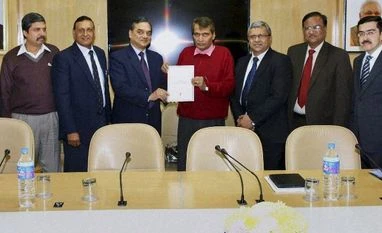 "Safety, passenger services and private participation initiatives dominated Railways in 2014")

