As the southwest monsoon continued its impressive run over most parts, pulses seem the biggest gainer. The sowing is already more than the average area grown in the past five kharif seasons.
As of Friday, pulses were sown on 11.03 million hectares, almost 41 per cent more than what was covered during the same period last year. The kharif average has been 10.8 mn ha.
The largest area has gone to arhar (split red gram), on 4.29 mn ha, 68 per cent more than last year. Its price had soared to a little over Rs 200 a kg at the start of 2016, which might have prompted farmers to plant in a big way. The Centre’s significant increase in the Minimum Support Price (MSP) and promise to purchase at market rates to build its own buffer seems to have also influenced farmers.
The area under urad (split black gram), moong (split green gram) and kulti (horse gram), the other main kharif pulses, has risen by 35 per cent, 38 per cent and 136 per cent as compared to the same period last year.
The biggest rise has been in the rainfed areas of Gujarat, Andhra Pradesh, Madhya Pradesh, Maharashtra, Rajasthan and Karnataka. Officials said large tracts earlier used for growing soybean in MP, guar in Rajasthan and cotton in Gujarat and Maharashtra have shifted to pulses this year, on expectation of better return and fear of pest attack in some existing crops. In Karnataka, there has been a natural increase in sown area.
In UP, farmers have sown pulses, mainly arhar, in the Bundelkhand region, under a drought for two years, with rains plentiful so far.
With the southwest monsoon expected to get more active over north and central India by the first week of August, the area is expected to expand.
The Centre expects pulses production this year to cross 20 million tonnes.
Pulses aside, kharif crops have been planted on 79.95 million ha, six per cent more than the area sown last year. Sowing has risen 16 per cent in the past week.
A buoyed central government on Friday fixed a target of procuring around 33 million tonnes of rice in the 2016-17 procurement season that will start from October, this target is almost 10 per cent more than target fixed for the current year (2015-16) and around 7 per cent more than actual rice procurement for this year which is around 31 million tonnes.
“The optimism in sowing in pulses is mainly due to good rains in rain-fed areas where predominantly pulses are sown during the kharif season, but the Centre’s intervention in hiking MSP and more importantly ensuring assured purchase to create a buffer has also contributed,” a leading expert said.
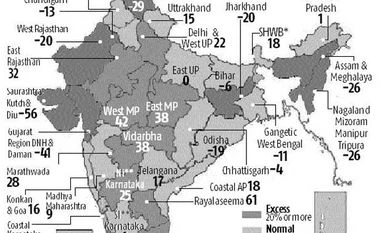
The monsoon did play its part and till Thursday the rains across the country this year was normal or excess in 80 per cent of the geographical area, while it was deficient or short in just 20 per cent.
The areas where the southwest monsoon was yet to make a mark was Saurashtra and Gujarat and also in Jharkhand, Assam, west Rajasthan and Himachal Pradesh.
Of these, Gujarat and Jharkhand are prominent agriculture states and a big drop in showers could cause a lot of distress as the showers in 2014 and 2015 have also not been very good.
In Gujarat, the southwest monsoon so far is around 40-50 per cent less than normal, while in Jharkhand it is around 20 per cent short of normal. Overall the rains are near normal across the country and in July, which is most crucial month for sowing of kharif crops it is around 108 per cent of the Long Period Average (LPA). The good rains have also filed up the reservoirs and on July 28, they were around 38 per cent of their full capacity, which at the start of monsoon season was only 17 per cent of capacity.

 "Sowing of pulses tops five-year average")


 Connect with us on WhatsApp