States with low tax mop-up in value-added tax regime get GST boost

New tax system benefitting consuming states more than manufacturing ones
Chart
Abhishek Waghmare New Delhi
Last Updated : Mar 04 2019 | 2:17 AM IST
Goods and services tax (GST) is rapidly becoming redistributive in nature, boosting the tax revenue of states that were low tax collectors in the erstwhile state value-added tax (VAT) regime. Though revenues of developed states dominate overall GST collection, their revenues are growing the slowest, according to data presented in Parliament.

Successive rate cuts and revenue shortfall have dominated the debate on GST. But as the GST system stabilises, it is showing signs of an outcome that was originally expected from it — benefitting consuming states such as Bihar and Jharkhand faster than manufacturing states such as Maharashtra and Tamil Nadu.

Experts and government officials said there are several reasons for this.

Firstly, the integrated GST (IGST), which is levied on imports and interstate transactions, is being distributed among states in a better manner than in the first year of implementation. Secondly, there is some limited evidence that services sector companies have started to concentrate their place of supply/compliance burden in one state, rather than having presence in many states.

And thirdly, there has been an improvement in reporting of business activity - better filing of returns - in consuming states in 2018-19.

Due to this, the overall share of IGST in the GST taxes pool has increased, and businesses in consuming states have started utilising the IGST credit to pay off state GST (SGST) more frequently, finance ministry officials said.

“Apart from a significant reduction in GST rates, the year-on-year comparison of states' GST revenues needs to consider the fact that the production/consumption patterns vary across states. And over a period of time, a broad pattern of incremental revenues for net consuming states is emerging," said M S Mani, partner, Deloitte.

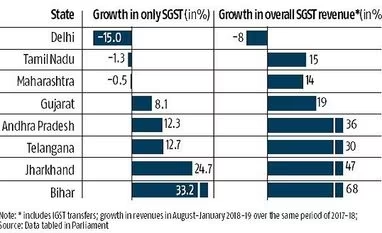
GST revenue of Bihar, Jharkhand, and Assam has grown by 68 per cent, 47 per cent and 45 per cent, respectively, in 2018-19. However, Maharashtra, Tamil Nadu, and Gujarat have seen modest growth of 14 per cent, 15 per cent and 19 per cent, respectively, over the previous financial year. These pertain to August-January collections in both financial years, and include settled IGST revenue in addition to SGST collection in that state.

There have been outliers as well: Andhra Pradesh and Telangana have shown a growth of more than 30 per cent, despite being net producing states. Kerala, despite being a net consuming state, has shown only 20 per cent growth.

The reasons for this are multifarious, experts and tax officials from multiple states told Business Standard. 

“As compliance improves in weaker states, it was expected that they get more incremental revenue under GST. After all, it's not the nature of being a consuming state, but the reporting of consumption that matters when it comes to state GST collection. A business transaction in 2018-19, which is similar to that in 2017-18 but with better reporting, has started benefitting states like ours,” said a senior tax officer in Bihar.

Pratik Jain, partner (indirect tax) at PwC India, said one reason for reduction in SGST could be the centralisation of compliances — payment of IGST from one place — by services companies in banking, telecom, and transport sectors.

Looking at SGST collection in isolation, the contrast is even wider. SGST collection in Maharashtra, Tamil Nadu, Kerala, Punjab, and Delhi has actually contracted in 2018-19. The reasons vary for states. The relative losers are sounding a note of concern, while states that are benefitting incrementally are well aware of the gains.

“Some services dealers in banking, insurance, and telecom have shown a bump in IGST payment but short-payment in SGST. The shortfall is linked with low-value high-volume consumption in the net consuming states, while high value consumption of services in the state,” said a senior tax official from Maharashtra.

Officials from Kerala, an outlier in the trend, said low return filing in the state is hurting their revenues. But more so, they pinpointed the reason for their pains to “gross under-valuation” and under-reporting happening under GST.

“No one would pay tax if no one is watching. Extension of deadlines is giving an impression of no action would be taken. Compliance culture under GST is falling and visibly in Kerala," said a state tax official on the condition of anonymity.

He also said the distribution of IGST among states under the provisional settlement is penalising some states, while giving undue revenue benefit to some others. But there is not data to prove this, he said.

SGST revenue of Delhi is contracted by a staggering 15 per cent in August - January 2018-19. Some officials said setting up inter-state trading business in Delhi is no more lucrative as it was in the erstwhile Central Sales Tax regime. Most businesses are leaving the state jurisdiction and are moving to Gurugram and Noida, which fall in Haryana and Uttar Pradesh, respectively.

As for the net producing states such as Maharashtra, they are looking at poor revenue growth in the medium term. But over time, the GST system will benefit all states, they believe.

One subscription. Two world-class reads.

Already subscribed? Log in

Subscribe to read the full story →
*Subscribe to Business Standard digital and get complimentary access to The New York Times

Smart Quarterly

₹900

3 Months

₹300/Month

SAVE 25%

Smart Essential

₹2,700

1 Year

₹225/Month

SAVE 46%
*Complimentary New York Times access for the 2nd year will be given after 12 months

Super Saver

₹3,900

2 Years

₹162/Month

Subscribe

Renews automatically, cancel anytime

Here’s what’s included in our digital subscription plans

Exclusive premium stories online

  • Over 30 premium stories daily, handpicked by our editors

Complimentary Access to The New York Times

  • News, Games, Cooking, Audio, Wirecutter & The Athletic

Business Standard Epaper

  • Digital replica of our daily newspaper — with options to read, save, and share

Curated Newsletters

  • Insights on markets, finance, politics, tech, and more delivered to your inbox

Market Analysis & Investment Insights

  • In-depth market analysis & insights with access to The Smart Investor

Archives

  • Repository of articles and publications dating back to 1997

Ad-free Reading

  • Uninterrupted reading experience with no advertisements

Seamless Access Across All Devices

  • Access Business Standard across devices — mobile, tablet, or PC, via web or app

Next Story



