Statsguru: Budget expectations

FM might also refer transitioning to a universal basic income (UBI) architecture in his Budget
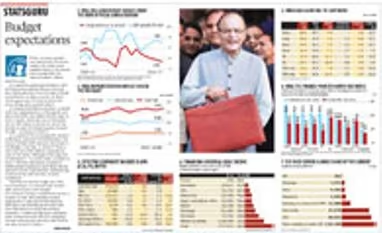
(Click on picture for details)
Ishan Bakshi
Last Updated : Jan 30 2017 | 12:19 PM IST
By all accounts, growth has slowed after demonetisation. But while some analysts expect it to bounce back quickly after full remonetisation, others aren’t so sure. 

It is what the government believes that will determine whether Finance Minister Arun Jaitley deviates from the path of fiscal consolidation or stays on track. As Chart 1 shows, governments tend to loosen the purse strings when growth falters. 

It is hoped that demonetisation, coupled with the implementation of the goods and service tax (GST), will widen the tax base. As Chart 2 shows, India has one of the lowest tax-to-GDP ratios in the world, which has  shown no signs of increasing over the past decade — as shown in Chart 3. 

It is expected that to assuage the people’s suffering on account of demonetisation, the finance minister will announce tax breaks in this Budget. Currently, as shown in Chart 4, India has one of the highest corporate tax rates in the world. Although when adjusted for exemptions, it is much lower, as shown in Chart 5. Perhaps, the earlier proposal to whittle down exemptions and lower the tax rate will now be implemented. Any lowering of personal tax rates will also increase compliance. 

The finance minister might also refer transitioning to a universal basic income (UBI) architecture in his Budget. 

The Economic Survey is expected to devote a chapter on this. But subsidies already account for 4.2 per cent of GDP and it is difficult to see how the government will fund UBI without cutting the existing subsidies. It could use the socio-economic caste census to ensure efficient targeting, thereby reducing the subsidies that flow to the rich, as seen in Chart 7.
 

One subscription. Two world-class reads.

Already subscribed? Log in

Subscribe to read the full story →
*Subscribe to Business Standard digital and get complimentary access to The New York Times

Smart Quarterly

₹900

3 Months

₹300/Month

SAVE 25%

Smart Essential

₹2,700

1 Year

₹225/Month

SAVE 46%
*Complimentary New York Times access for the 2nd year will be given after 12 months

Super Saver

₹3,900

2 Years

₹162/Month

Subscribe

Renews automatically, cancel anytime

Here’s what’s included in our digital subscription plans

Exclusive premium stories online

  • Over 30 premium stories daily, handpicked by our editors

Complimentary Access to The New York Times

  • News, Games, Cooking, Audio, Wirecutter & The Athletic

Business Standard Epaper

  • Digital replica of our daily newspaper — with options to read, save, and share

Curated Newsletters

  • Insights on markets, finance, politics, tech, and more delivered to your inbox

Market Analysis & Investment Insights

  • In-depth market analysis & insights with access to The Smart Investor

Archives

  • Repository of articles and publications dating back to 1997

Ad-free Reading

  • Uninterrupted reading experience with no advertisements

Seamless Access Across All Devices

  • Access Business Standard across devices — mobile, tablet, or PC, via web or app

Next Story



