Talgo trial runs conducted without safety clearance
Talgo had trial runs on the high traffic routes of Delhi-Mumbai, Mathura-Palwal and Bareilly-Moradabad. The fourth run was abruptly postponed
Shine JacobArindam Majumder New Delhi The Indian Railways' trial runs of the high-speed train Talgo have come under the scanner with the Commissioner of Railway Safety (CRS) hauling up the national transporter for not seeking a safety clearance.
Talgo had trial runs in the high traffic routes of Delhi-Mumbai, Mathura-Palwal and Bareilly-Moradabad earlier this month, The fourth run was, however, abruptly postponed.
While the railways said the cancellation was because of heavy rains and because the Talgo team wanted a break and that the final trial is now likely to take place in September, official sources said CRS has in a letter written to the ministry of railways objected to the trials citing safety reasons.
The railways disregarded the letter, saying the Railway Board had already given clearance and that CRS takes an average time of 18 months to give clearance.
"The trial run was rushed without a clearance from CRS. Any trial run for trains above the speed of 130 km per hour needs clearance," said an official privy to the matter. Besides rolling stock, reopening of new lines too require CRS clearance.
CRS deals with matters of safety of rail travel and train operations and is charged with statutory functions laid down in the Railways Act (1989), which are of an inspectorial, investigatory and advisory nature.
A railway official said the Talgo run was only a trial and, in case of launch of commercial services, clearance from CRS would be taken. A former mechanical engineer of the Indian Railways, however, said it is mandatory to get CRS clearance even for trial runs. "In cases where an imported locomotive is transported from a port to railway workshop, CRS clearance is required. They cannot run a full train on the Delhi-Mumbai route without clearance. Who will take responsibility if the trial train falls on the adjoining track and people are killed?" he said.
The Talgo coaches were shipped from Spain to Mumbai at the company's expense and, hence, the cost incurred by the railways was negligible. Earlier this month, Talgo became the fastest train to run in India, clocking a speed of 180 km per hour, covering the 84-km stretch between Mathura to Palwal in 38 minutes, breaking the record set by the Gatimaan express in April.
Though critics say Talgo failed to break speed benchmarks, the railways consider it a success.
During the first trial run between Delhi and Mumbai on August 2, the train took 15 hours and 50 minutes to reach the destination, as against the expected 12 hours and 47 minutes. In the second trial run on August 5, while the claim was 12.47 hours, it took 13.17 hours to reach the destination. During the third trial on August 9, the train took 12.56 hours, compared to a claim of 12.26 hours by the company.
"In all these cases, there were some unusual occurrences because of some technical issues with the railways that slowed the train's speed. If you subtract this error, the train was successful," said an official close to the development.
In comparison, the super-fast Rajdhani Express takes 15 hours and 50 minutes from New Delhi to Mumbai Central. While the average speed of the Rajdhani between New Delhi and Surat is 89.76 kmph, Talgo cloaked an average speed of 106.52 kmph. According to the railways, the train took 118 mins less than the Rajdhani on the stretch.
The first trial run suffered because of factors such as occurrences heavy rains between Surat and Mumbai Central. However, in the clear stretch from Mathura to Surat it took 85 minutes less than the Rajdhani. The second trial run was conducted at a maximum permissible speed of 130 kmph with cant deficiency value of 125 mm. The third trial run was conducted at a speed of 140 kmph with cant deficiency value of 125mm.
The Talgo that covered the Delhi-Mumbai route had nine coaches, comprising two executive coaches, four general coaches, a cafeteria, power car and a tail-end coach.

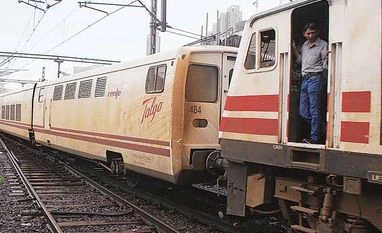 "Talgo trial runs conducted without safety clearance")


 Connect with us on WhatsApp