Tamil Nadu parties raise pitch on household income support, flirt with UBI

Going to polls, all competing parties in the state have announced cash support in some form or the other. States' initiatives usually land up in the Centre's kitty of welfare schemes later

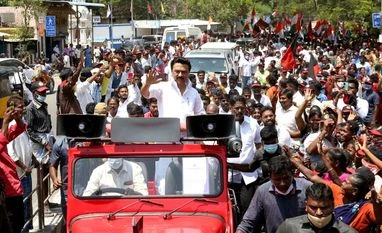
Dravida Munnetra Kazhagam (DMK) party president M.K. Stalin gestures to supporters during a rally after filing his nomination ahead of Tamil Nadu state legislative assembly elections, in Chennai on Monday.
File photo of DMK party president M.K. Stalin gesturing to supporters during a rally after filing his nomination ahead of Tamil Nadu state legislative assembly elections
Abhishek Waghmare Pune
7 min read Last Updated : Mar 31 2021 | 4:51 PM IST
The season of elections in India has always been ripe for bold policy experimentation. As four states and a union territory go to polls, what catches the eye this time is the direct cash transfer announced by contesting parties in Tamil Nadu. 

Earlier this year, Kamal Haasan’s Makkal Needhi Maiam (MNM) announced a monthly income support of Rs 3,000 to women homemakers in the state to compensate for the household chores they do without getting paid. But his political venture is still new to make this reverberate in the political discourse. 

DMK (Dravida Munnetra Kazhagham), the main opposition, announced that it will provide Rs 1,000 per month (Rs 12,000 per year) to the woman head of each family in Tamil Nadu, if voted to power. This raised eyebrows. 

The cash promise became a sensation when the ruling AIADMK (All India Anna Dravida Munnetra Kazhagham) promptly pounced on this opportunity, and announced Rs 1,500 per month per household (Rs 18,000 a year), making it the most universal version of this kind. 

However, no freebie or benefit comes without a cost. In fact, bigger the poll promise, the greater the need for financial resources. 

For Tamil Nadu, a scheme of this kind may take up a fourth—or even a third—of the state’s annual developmental spending. This will either mean the debt burden will increase substantially, else the state would have to let go spending in other areas. 

Secondly, a scheme of such kind also has the potential to disrupt the policymaking scene in India. The political mileage of this scheme may lure the Centre to take this up at the national stage, as it has done multiple times before. 

Thirdly, such a scheme, especially the MNM version, also touches upon the dignity of Indian women, who lead among women in the world in terms of spending the most time on unpaid household chores. 

Not just Tamil Nadu, but Madhya Pradesh, Rajasthan, and some other states are taking similar policy directions. These developments may take India closer to a Universal Basic Income. 

First, let us look at how much resources such a scheme would need.

Excellent scheme, but who will finance it?

Tamil Nadu had a population of 72 million in 2011, with nearly 18.5 million households. Of them, 9.6 million households are rural and 8.9 million are urban, the country’s highest extent of urbanisation, according to Census 2011 data

But the state has been meticulous in bringing the entire population under the ambit of ration cards, and there are 21 million active ration cards in the state, suggesting coverage across almost all families residing in the state. The poll announcements suggest that one ration card may get treated as one household. 

At this rate, the proposal by DMK that promises Rs 1000 per month to each family would need Rs 25,000 crore ($3.5 bn) annually. The AIADMK’s proposal, on the other hand, could go to Rs 38,000 ($5 bn) crore. This money—1.3 to 1.9 per cent of state GDP—would have to be spent from the state’s coffers, and will put massive pressure on the state’s finances.

Now, Tamil Nadu has projected that it will spend Rs 3 trillion this year, the deputy chief minister announced in the Budget. At the outset, an income transfer scheme of this magnitude will demand 10 per cent of funds from the annual Budget. 

But as much as Rs 43,000 crore will go towards capital expenditure, and close to Rs 2.6 trillion has been kept aside for current spending. Of this, Rs 1.6 trillion goes towards committed spending areas such as salaries, pensions, and interest payments and non-wage administration expenses, leaving out Rs 1 trillion for developmental spending. 

The household income support scheme would thus eat into 25-40 per cent of the annual spending room that Tamil Nadu has. 

However big the promise sounds, the fiscal logic does not seem to be sound. When the poll promise will transform into a scheme by the government—if it does—it is likely to have big exclusions to make it financially viable. 

While this was how the impact would be inside TN, the domino effect outside the state cannot be overlooked.

High impact state schemes are always on Centre’s policy radar

It was May 2018, and a year before facing the first election as incumbent, the Telangana government headed by KC Rao announced a scheme Rythu Bandhu, to transfer Rs 8000 to all farmer households. 

While this was first such scheme in India, Odisha announced a similar scheme (KALIA), followed by Andhra Pradesh (Rythu Bharosa), West Bengal and Jharkhand within a year or two.

But the climax was the announcement of PM-KISAN by the central government, which gave all farmers in the country Rs 6,000 per year. The Centre, thus, took up an immensely popular (or populist) scheme with a demonstrated experience at the state level, took 120 million farmers under its fold initially, and later extended it to 142 million tillers in the country. 

Telangana has now topped it up to Rs 12,000 per farmer family a year, while AP gives Rs 13,500 per farmer a year. 

The mid-day meal scheme began in Tamil Nadu in 1982. Rural employment guarantee, which currently manifests in the Mahatma Gandhi National Rural Employment Guarantee Scheme, saw its first version in Maharashtra in 1972. 

Universal basic income: one step closer?

The poll announcement in Tamil Nadu points to a cash support to every family due to good penetration of ration cards, thus making it close to a universal scheme. 

Indian policymakers have, for years, toyed with the idea of a UBI, especially when India houses the highest number of poor in the world: about one in five Indians is poor by the World Bank standards. 

Talking about a possible UBI in India, the Economic Survey of 2016-17 had argued that Rs 7,620 per person per year would be the right amount of UBI for the year 2016-17. This could translate to a notch near to Rs 10,000 per year per capita today, accounting for inflation in the last five years. 

But the Survey also mentioned that the fiscal space for such a scheme should be carved out from existing subsidies, and centrally sponsored schemes. 

Though the amount in Tamil Nadu’s proposed model comes closer to the one proposed by the then chief economic advisor Arvind Subramanian in the Economic Survey, the challenging fact that the state government may have to subsume some key subsidies and welfare schemes remains. 

Economists have proposed UBI schemes in their many avatars. One such scheme, presented by Maitreesh Ghatak and Karthik Muralidharan suggests transferring Rs 120 to every Indian every month, which will mean close to Rs 1,500 per year, and would cost India 1 per cent of its GDP. PM-KISAN, on the other hand, targets only farmers and costs 0.3-0.4 per cent of GDP. 

Women’s dignity of work

The Economic Survey mentioned above talks briefly about a UBI for women. But actor-turned politician Kamal Haasan specifically announced a cash transfer of Rs 3,000 per month (annual income of Rs 36,000) to women who take care of the household. 

This is indeed interesting especially in a situation where Indian women work hardest without pay among most countries.

Data by Organisation for Economic Cooperation and Development (OECD) shows that Indian women spend six hours daily on household chores without any pay, more than women in any other country.

This poll promise, however, is from the stable of a relatively smaller party. The bigwig contenders have, nevertheless, promised the cash transfer to women in the family.

One subscription. Two world-class reads.

Already subscribed? Log in

Subscribe to read the full story →
*Subscribe to Business Standard digital and get complimentary access to The New York Times

Smart Quarterly

₹900

3 Months

₹300/Month

SAVE 25%

Smart Essential

₹2,700

1 Year

₹225/Month

SAVE 46%
*Complimentary New York Times access for the 2nd year will be given after 12 months

Super Saver

₹3,900

2 Years

₹162/Month

Subscribe

Renews automatically, cancel anytime

Here’s what’s included in our digital subscription plans

Exclusive premium stories online

  • Over 30 premium stories daily, handpicked by our editors

Complimentary Access to The New York Times

  • News, Games, Cooking, Audio, Wirecutter & The Athletic

Business Standard Epaper

  • Digital replica of our daily newspaper — with options to read, save, and share

Curated Newsletters

  • Insights on markets, finance, politics, tech, and more delivered to your inbox

Market Analysis & Investment Insights

  • In-depth market analysis & insights with access to The Smart Investor

Archives

  • Repository of articles and publications dating back to 1997

Ad-free Reading

  • Uninterrupted reading experience with no advertisements

Seamless Access Across All Devices

  • Access Business Standard across devices — mobile, tablet, or PC, via web or app

Topics :Tamil Nadu electionsUniversal basic income

Next Story