Tea plantation firms brew own brands to capture retail segment

This year marked the entry of the world's largest tea producer, McLeod Russel, into the packet tea business
graph
Avishek Rakshit Kolkata
Last Updated : Nov 18 2017 | 1:17 AM IST
Tea plantation companies are focussing on packet teas to mitigate risks in the plantation business as well as to tap new revenue streams.

This year marked the entry of the world’s largest tea producer, 

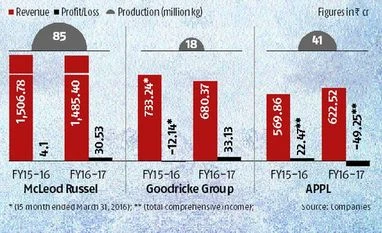
McLeod Russel, into the packet tea business while the country’s second largest tea manufacturer, Amalgamated Plantations, also decided on a retail venture. The Camellia-owned Goodricke group strengthened its retail portfolio after acquiring several brands from Godfrey Phillips.

The tea business has been subject to severe stress since 2014. With a wage revision being implemented across estates, the cost of production has increased by 35-40 per cent to Rs 135-140 a kg in Assam and West Bengal while prices in auctions have risen by only 5-7 per cent. This has made the business unsustainable with plantation companies facing the brunt.

Jagjeet Kandal, managing director of Amalgamated Plantations that recently launched a new brand, Hattigor Gold, and plans to come up with another one next year, is of the view that the retail venture will ensure better margins for the company.

The packet tea venture provides Amalgamated Plantations Rs 10-15 additional margin on every kg sold. In the near term, Amalgamated Plantations, which has accumulated Rs 85 crore in losses, targets selling 300,000-500,000 kg of packet tea every year, which will translate into Rs 30-75 lakh of additional profit. 

McLeod Russel expects to churn Rs 150-200 crore of additional revenue from its maiden retail venture, and this is expected to reach Rs 300 crore in the near term.

In a recent development, Eveready Industries offloaded 50 per cent of its stake in its tea retail subsidiary, Greendale, to McLeod Russel while transferring the brand rights to this subsidiary.

Both McLeod Russel and Eveready Industries belong to the Williamson Magor group owned by the Khaitan family.

“The major revenue is expected from the plantations business, but the retail venture will open a new revenue stream and contribute directly to the bottom line of the company,” said Kamal Kishore Baheti, director, McLeod Russel.

The Goodricke group, which has a retail line of business apart from its mainstay plantations, is also optimistic. Its packaged tea venture contributes 26 per cent to the company’s annual turnover of Rs 680 crore. Vikram Singh Gulia, vice- president at the Goodricke group, wants to increase this contribution to 40 per cent in a few years.

Ajay Kichlu, director at Chamong Tea Exports that retails green and Darjeeling tea, is also preparing a roadmap to increase the retail business. “I would definitely like to expand the retail business. Our tea is available across the country, but in select pockets. I would like to change this scenario,” he said.

Chamong Tea Exports owns 17 gardens in Assam and West Bengal.

It is likely that these companies will procure a major part of their green leaf for the retail ventures from small tea growers, thereby reducing their input cost. 

The Indian Tea Association has pointed out frequently that adherence to the Plantation Act, 1951, and the Payment of Bonus Act, 1965, raises the cost of production for tea estates. 

“It has created an imbalance. Small tea gardens, owing to their low cost of production, can sell their produce at prices that are unsustainable for tea estates,” an industry executive said.

Tea plantation companies are likely to sell the bulk of their own produce in auctions and private sales while procuring tea from small gardens and mixing a part of it with their own produce for their retail ventures.

The packet tea business does not require substantial capital investment. Amalgamated Plantations, which operates facilities to pack tea for Tata Global Beverages, its parent company, has the infrastructure in place.

The Goodricke group has bought trademark and brand rights for Rs 20 crore while a similar amount will be paid by Greendale to Eveready Industries for acquisition of brand rights.


One subscription. Two world-class reads.

Already subscribed? Log in

Subscribe to read the full story →
*Subscribe to Business Standard digital and get complimentary access to The New York Times

Smart Quarterly

₹900

3 Months

₹300/Month

SAVE 25%

Smart Essential

₹2,700

1 Year

₹225/Month

SAVE 46%
*Complimentary New York Times access for the 2nd year will be given after 12 months

Super Saver

₹3,900

2 Years

₹162/Month

Subscribe

Renews automatically, cancel anytime

Here’s what’s included in our digital subscription plans

Exclusive premium stories online

  • Over 30 premium stories daily, handpicked by our editors

Complimentary Access to The New York Times

  • News, Games, Cooking, Audio, Wirecutter & The Athletic

Business Standard Epaper

  • Digital replica of our daily newspaper — with options to read, save, and share

Curated Newsletters

  • Insights on markets, finance, politics, tech, and more delivered to your inbox

Market Analysis & Investment Insights

  • In-depth market analysis & insights with access to The Smart Investor

Archives

  • Repository of articles and publications dating back to 1997

Ad-free Reading

  • Uninterrupted reading experience with no advertisements

Seamless Access Across All Devices

  • Access Business Standard across devices — mobile, tablet, or PC, via web or app

Next Story



