
Trudeau gets India's promise on quarantine arrangement for Canadian pulses
Record domestic production, strict quarantine rules have slowed pulses imports from Canada
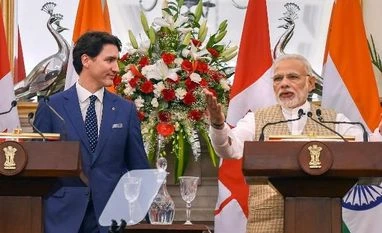 "Trudeau gets India's promise on quarantine arrangement for Canadian pulses")
premium
Explore Business Standard

Associate Sponsors
Co-sponsor
Record domestic production, strict quarantine rules have slowed pulses imports from Canada
A promise by the Indian government on easing of quarantine rules for import of pulses from Canada might be the best policy achievement for Prime Minister Justin Trudeau after his week's trip to this country.
On Friday, both sides committed to 'finalise an arrangement within 2018 to enable the export of Canadian pulses to India, free from pests of quarantine importance, with mutually acceptable technological protocols', according to the statement issued after Trudeau met counterpart, Narendra Modi. Food safety regulators of both nations would work closely in this regard, it said.
India is the world's largest producer, processor, importer and consumer of pulses; its production has risen over recent years, affecting major shippers such as Canada. And, Delhi has continued to demand that pulses from the nation be fumigated with methyl bromide; Canada doesn't permit chemical fumigation agents.
Of the $4.1 billion of import from Canada in 2016-17, shipment of pulses - yellow peas, green peas and red lentils (masur) - amounted to $1.1 bn. This constitutes a little over a quarter of pulses imported by India. The second largest lot of shipment was from Australia, another country that has complained of stocks piling up as India has stopped buying.
"Farmers will look at other crops as prices have fallen dramatically and there will be a 15-30 per cent reduction in pulse cultivation in Canada," recently said Gordon Bacon, chief executive of Pulse Canada. While Canadian provinces which grow it becoming concerned, pulses became an agenda item on the visiting officials' trade list. Several ministerial delegations, including that of Canadian trade minister Francois Champagne, had raised it in 2017. Securing the new promise by India will be helpful for the Trudeau administration, facing some media criticism back home for the lengthy tour at taxpayer expense.
Delhi doesn't expect to be adversely affected by a possible quarantine arrangement. "Trade will take its course but India will not be affected by price changes. We hope to work on it along with the agriculture ministry over the coming months." a senior commerce ministry official said.
India harvested a record crop of 23 million tonnes (mt) in 2016-17, sharply up from 16.4 mt in 2015-16. The production cycle is robust and if the government continues with its commitment on Minimum Support Price, the harvest is expected to continue growing annually, says Pravin Dongre, chairman of the India Pulses and Grains Association.
He adds that import from Canada is not expected to suddenly rise after an arrangement is finalised, as large domestic production has meant these are already at optimal levels and Canadian shipments continue to be fumigated in the transportation phase.
On the larger trade scenario, Trudeau's push on bilateral merchandise trade has to contend with policy blockages. Despite Canada's southern neighbour, America, being India's largest export destination, Indo-Canadian trade has remained was only $6.1 billion in 2016-17, down two per cent from the year before.
Currently, India and Canada are engaged in negotiating a Foreign Investment Promotion and Protection Agreement (FIPPA), beside a Comprehensive Economic Partnership Agreement, a pact for freer trade. Talks on FIPPA had earlier been stalled by Delhi's decision to conduct negotiations for all investment pacts under the framework of a model Bilateral Investment Treaty issued by the government in 2015.
Export from India to Canada is broad-based; no commodity constitutes more than eight per cent of all outbound trade. Medicines, shrimp and prawn, and jewellery are the major export items from India.
Already subscribed? Log in
Subscribe to read the full story →

3 Months
₹300/Month
1 Year
₹225/Month
2 Years
₹162/Month
Renews automatically, cancel anytime

Over 30 premium stories daily, handpicked by our editors


News, Games, Cooking, Audio, Wirecutter & The Athletic
Digital replica of our daily newspaper — with options to read, save, and share


Insights on markets, finance, politics, tech, and more delivered to your inbox
In-depth market analysis & insights with access to The Smart Investor


Repository of articles and publications dating back to 1997
Uninterrupted reading experience with no advertisements


Access Business Standard across devices — mobile, tablet, or PC, via web or app
First Published: Feb 24 2018 | 1:00 AM IST

