India will furnish a rebuttal at the World Trade Organization (WTO) against allegations that it underreported the subsidy amount paid to cotton growers as part of the Minimum Support Price (MSP) programme.
Last week, Washington DC told the WTO that India has given subsidies ranging between 53 per cent and 81 per cent of the value of production from 2010-11 to 2016-17, much higher than the 10 per cent limit allowed by the multilateral body. However, rather than calculating product subsidies provided by India in US dollar, the US government has furnished figures for India in rupee, which ballooned the figure, commerce department officials said. India has traditionally used US dollar as part of its calculations, which was then submitted to the WTO.
A similar problem arose in case of wheat subsidies a few months ago, commerce department officials said.
On the contrary, documents vetted by the Committee of Agriculture show, the US provided a much higher support to American cotton producers than India.
These issues will be highlighted as part of New Delhi's second response to the Committee of Agriculture at the WTO, which is expected soon. It will also list out the multiple times Washington DC has used the ‘currency trick’ to allege India, the most recent of which happened a few months back regarding wheat and rice. India had earlier said that US trade officials wrongly assumed the entire crop is valid for subsidies in India.
India is also trying to gain support from other nations on the issue, according to a trade negotiator. The country has argued against the official method used to calculate MSP at the WTO.
But senior government sources said the commerce department has asked for the revised MSP figures for 2016, 2017 and advance figures for 2018 from the ministries of Agriculture and Textiles. We will submit the figures to the WTO to rest the matter soon, the official added.
Market prices remain high
The central government raised the MSP on medium-staple and long-staple fiber cotton by 28 per cent and 26 per cent, respectively. The MSP of cotton (medium staple) was raised to Rs 5,150 per quintal from Rs 4,020 per quintal and that of cotton (long staple) to Rs 5,450 per quintal from Rs 4,320 per quintal.
Back in July, the central government raised the MSP on medium-staple and long-staple fiber cotton by 28 per cent and 26 per cent. “There is no case for raising the MSP as market prices are much higher at the moment. However, that may change from Wednesday when the Cotton Advisory Board estimates annual production of the crop,” Siddhartha Rajagopal, executive director at the Cotton Textiles Export Promotion Council of India.
This was echoed by officials at the Cotton Corporation of India, which procures cotton from farmers, said.
Earlier this year, apex trade body Cotton Association of India in its first estimates had pegged the 2018-19 crop size at 34.8 million bales. This was lower than 36.5 million bales produced in 2017-18 on account of deficient rains hurting the output in major states such as Gujarat, Maharashtra and Karnataka.
The WTO Agreement on Agriculture defines subsidies on the total value of agriculture production, while the US has challenged India on the basis of support given to individual products. However, the agreement doesn’t specify the currency in which countries have to report their subsidy, but India has consistently provided data in US dollar.
“While the United States does not provide market support price to its farmers, it allows ‘non-exempt direct payments’ and other kinds of product specific support to producers. As opposed to this, India's total support is in the form of market support price,” Jayant Dasgupta, India's former Ambassador to the WTO said.

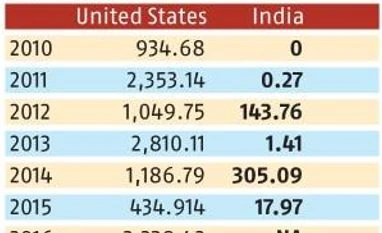 "US inflated Indian cotton subsidy by measuring in Rupee: India to tell WTO")












