We've seen healthy growth in term loans: SBI chairman Rajnish Kumar

Rajnish Kumar, chairman, State Bank of India (SBI), says the economy has bottomed out and there is a need to revive the capital expenditure cycle
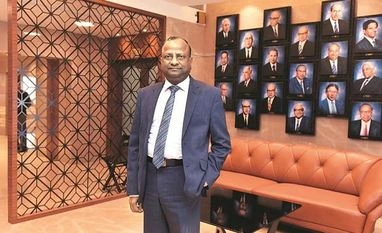
SBI Chairman Rajnish Kumar
Subrata PandaAbhijit LeleDev Chatterjee
5 min read Last Updated : Jan 02 2020 | 2:53 AM IST
Amid the slowing economy, muted credit growth, and the Reserve Bank of India’s (RBI’s) warning that non-performing assets may rise, Rajnish Kumar, chairman, State Bank of India (SBI), tells Subrata Panda, Abhijit Lele and Dev Chatterjee in an interview that the economy has bottomed out and there is a need to revive the capital expenditure cycle. He also emphasises the success of the Insolvency and Bankruptcy Code and says that lenders need at least nine to 10 months to resolve stressed accounts under the RBI’s June 7 circular. Edited excerpts:

How do you assess the economic situation now?

I think the economy has bottomed out, and we should see an upward trend from now. The third quarter of FY20 has been good. There are global headwinds and all the major economies are under pressure, apart from the US. So, this is impacting our exports. But, on the domestic front, a revival of the capex cycle of the private sector is the most important thing. And, that can happen with infrastructure upgrade.

How is your corporate lending segment doing?

Working capital utilisation is still subdued, and is less than what it was in March. On the other hand, we have had healthy growth in the term loans segment. As of December, SBI has seen term loans grow 16 per cent year-on-year to Rs 1.72 trillion. Last year, it was an exceptional situation for us because we had very large credit disbursements in the second half. This year, it is more in line with what used to happen in the previous years. In our domestic market, our advances are lagging by Rs 40,000 crore from what they were last year. However, we have seen good growth in the international banking group. So, in terms of overall advances, we are more or less at the March 2019 level.

What is your assessment of the inter-creditor agreement (ICA) framework under the June 7 circular?

There are 34 accounts where an ICA has been signed. If we leave out Dewan Housing Finance (DHFL), then in the January-March quarter we are hoping that we won’t see any surprises on the asset quality front. Of the 34 accounts, 21 are already non-performing assets (NPAs) and that constitutes a major chunk of the bad assets. SBI has an exposure of Rs 57,000 crore in the 34 accounts and the entire banking system would have an exposure of around Rs 2 trillion. 

Is the ICA working?

The framework is alright. What we feel is it is difficult to resolve a company within six-seven months. So, for the ICA to function properly, at least nine to 10 months should be given. But if the resolution doesn’t happen within the prescribed time, then we cannot refer all the companies to the National Company Law Tribunal (NCLT). Now, lenders are taking a conscious call on what will be the recoveries if an account is referred to the NCLT. 

Do you think the Insolvency and Bankruptcy Code (IBC) has been successful?

I am very satisfied with the IBC after the Essar Steel judgment. Foreign investors will also come back. We have seen foreign direct investment of more than Rs 42,000 crore in Essar Steel from ArcelorMittal, which is positive for the economy and the banking sector, as there will be further investments in that company. RattanIndia too has seen foreign investors coming in. We are seeing many resolutions happening. In December itself, we saw four — Essar Steel, Ruchi Soya, Prayagraj Power, and RattanIndia. Most probably Jaypee Infratech will be resolved by March. Then we may have Bhushan Power and Steel, Alok Industries, and Reliance Communications. 
 
Are concerns about the asset quality of non-banking financial companies (NBFCs) stabilised?

Yes, NBFCs have substantial exposure to the real estate sector. Realtors who were holding on to inventory are now trying to get rid of them. There have been price corrections across several geographies. The National Capital Region has a lot of problem, but there is not so much of a problem in Bengaluru, Hyderabad, and Chennai.

So, it is true that there is huge inventory build-up, but this is not new. Now, the new launches have become less and some of the inventory is also getting cleared up. So, this will bring stability to the demand-supply problem.
 
Are you concerned about the Mudra loan portfolio?

SBI’s Mudra loan portfolio is 1.1 per cent of the loan book. So, even if there is 10 per cent NPA in that segment, it will not impact us that much. What impact us are accounts such as DHFL because suddenly Rs 10,000 crore worth of loans become NPA.

The RBI said NPAs may rise to 9.9 per cent by September 2020. What is your view?

Maybe the RBI is taking the telecom sector into consideration. Otherwise, I expect SBI’s NPAs to be around 6-6.5 per cent in March 2020. I don’t think SBI will contribute much to the rise in NPAs.

Do you see any immediate concern from the telecom sector?

I wouldn’t say we are not concerned. We have a large exposure to that sector. So, as long as the issues are not sorted out in the sector, there will be concerns.

One subscription. Two world-class reads.

Already subscribed? Log in

Subscribe to read the full story →
*Subscribe to Business Standard digital and get complimentary access to The New York Times

Smart Quarterly

₹900

3 Months

₹300/Month

SAVE 25%

Smart Essential

₹2,700

1 Year

₹225/Month

SAVE 46%
*Complimentary New York Times access for the 2nd year will be given after 12 months

Super Saver

₹3,900

2 Years

₹162/Month

Subscribe

Renews automatically, cancel anytime

Here’s what’s included in our digital subscription plans

Exclusive premium stories online

  • Over 30 premium stories daily, handpicked by our editors

Complimentary Access to The New York Times

  • News, Games, Cooking, Audio, Wirecutter & The Athletic

Business Standard Epaper

  • Digital replica of our daily newspaper — with options to read, save, and share

Curated Newsletters

  • Insights on markets, finance, politics, tech, and more delivered to your inbox

Market Analysis & Investment Insights

  • In-depth market analysis & insights with access to The Smart Investor

Archives

  • Repository of articles and publications dating back to 1997

Ad-free Reading

  • Uninterrupted reading experience with no advertisements

Seamless Access Across All Devices

  • Access Business Standard across devices — mobile, tablet, or PC, via web or app

Topics :SBI chairmanSBI chairman Rajnish KumarIndian EconomyMudra loanstelecom sectorEconomic slowdown

Next Story



