Earlier this month, the Central government said in a reply in Parliament that it has taken several measures to double farmers’ income by 2022 and that the progress made so far indicates that it is ‘on the right track’.
However, a closer look at the data and at the assumptions made thereof shows that as of now, it appears that the country seems quite unlikely to achieve that goal in real terms by FY23 end.
The Ashok Dalwai Committee on Doubling Farmers’ Income, set up by the Central government, had categorically said in its 14-volume report that in order for the cultivator's income from both farm and non-farm sources to double by 2022-23 (the terminal year), his earnings would have to grow by 10.4 per cent a year starting 2015-16. Moreover, this growth would have to be in real or inflation-adjusted terms, not in nominal terms.
“It is the real income of farmers that is to be doubled and not their nominal income,” the Committee had said.
It had pegged the average annual income of an agricultural household in 2015-16 at Rs 96,703. This was projected to grow to Rs 1,72,694 by 2022-23, that is, by the end of the current financial year.
At current prices, the growth would have to be stepped up further to a rate of as much as 15.9 per cent.
However, the latest situational assessment survey on NSSO released last year showed that the real income of an agriculture household from all sources grew by about 21 per cent between 2012-13 and 2018-19 (six years).
This translates into an average annual growth of just 3.5 per cent ore thereabouts in real terms.
In nominal terms, the income grew by 60 per cent between 2012-13 and 2018-19, or an annual average of 10 per cent.
Expecting the same income to grow by a staggering 10.4 per cent in real terms in between 2015-16 and 2022-23, when actual growth rates have been less than half of the targeted, seems over ambitious.
Several experts said that based on the latest Situational Assessment Survey, it should be prudent to expect farmer’s income to in 3-4 years beyond 2022-23.
In the first place, the target was unrealistic and ‘highly ambitious’ feels Dr S Mahendra Dev, Director of Indira Gandhi Institute of Development Research (IGIDR).
He said the Situational Assessment Survey of NSSO clearly showed how the target of achieving 10.4 per cent annual real income growth is highly improbable, when the average annual growth in real incomes has been a mere 3.5 per cent during the preceding period.
“Yes, if the nominal rate of growth in incomes is considered, then there could have been some (chance of) meeting of the target, but the key metric here is inflation-adjusted ot real income,” Dev told Business Standard.
He said the policies to achieve the growth rates have not been clearly articulated, and that the Centre needs to lay down a clear roadmap to wean farmers away from rice and wheat towards more lucrative, high-value crops.
“Now, if the incomes are even doubled within the next 3-4 years, considering an annual average growth of 3.5 per cent, it remains to be seen to what extent this will benefit small and marginal farmers, who form the bulk of India’s farming community,” Dev added.
Shweta Saini, an independent economist, says that not only were the targets set ‘unrealistically', but the drought of 2015 and the impact of demonetisation after that on farming made them all the more difficult to achieve.
“I don’t know what the impact of income transfers such as PM-KISAN on incomes has been after 2018, but the high price of inputs and low yields would definitely have impacted real income growth in the latter half of the targeted period,” Saini told Business Standard.
She said that the target was also ‘unrealistic’, as rarely has any state in the country seen its agriculture grow at a pace that doubled farmers’ income within seven years.
Saini, along with eminent agriculture economist Ashok Gulati, said in a paper published in 2018-19 that Prime Minister’s Narendra Modi’s dream of doubling farmers income by 2022-23 is unlikely to be realised, mainly on two accounts. The first of these is that four of the seven years have gone by with an average farm GDP growth rate of 3.7 per cent, which is much lower than the required rate of 10.4 per cent. The second factor is that profitability has been declining in recent years due to plummeting agricultural prices and rising cultivation costs, especially labour.
The authors add that during the first five-year tenure of the Modi government, i.e., 2014–15 to 2018–19, the average annual agricultural GDP growth rate in the country was 2.9 per cent.
If one assumes that farmers’ incomes broadly increase in tandem with the rate agricultural GDP growth, as has been the case during the past decade, it is obvious that the country lags far behind the required CAGR of 10.4 per cent, which is the annual growth rate required to achieve Modi’s dream of doubling farmers’ real incomes by 2022–23.
“This means that in the remaining years until 2022–23, farmers’ real incomes need to increase by 13–15 per cent per annum,” the paper said.


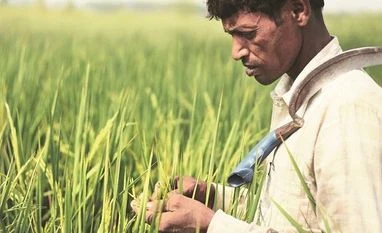 "Why India is unlikely to double farmers' income by the end of this fiscal")









