Withdrawal of 2018 southwest monsoon delayed; North India to see heavy rain

The revised forecast said the monsoon withdrawal would start from September 10-12. Now, it seems this will take longer
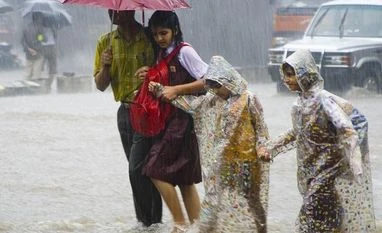
Monsoon
Monsoon. (Photo: Shutterstock)
Sanjeeb Mukherjee New Delhi
Last Updated : Sep 18 2018 | 1:43 AM IST
A new low pressure over the Bay of Bengal and a western disturbance are likely to further delay the withdrawal of the southwest monsoon this year and cause rainfall over north India over the weekend. The rains were supposed to retreat from September 1.

The revised forecast said the monsoon withdrawal would start from September 10-12. Now, it seems this will take longer.

“The withdrawal will not start this week,” India Meteorological Department (IMD) Director General K J Ramesh said.

The rains usually start withdrawing from early September from western Rajasthan. The process is usually complete by end-October, signaling the end of the four-month season that starts in June. For the past few years, withdrawal has been delayed.

The delay might aide planting of rabi crops, but if the showers are more than expected they might cause damage to the standing kharif harvest, particularly crops sown late.

A likely western disturbance over north India during the weekend might cause heavy to very heavy showers in a few places, including New Delhi.

“Heavy to very heavy rain is likely over north India from 23 September… All states must be warned for flooding,” Jatin Singh, chief executive officer of private weather forecasting agency Skymet, tweeted.

Till September 17, the southwest monsoon has been 9 per cent below normal with rains deficient in 12 of the 36 meteorological sub-divisions. These include west Rajasthan, Saurashtra, Gujarat, north interior Karnataka, Rayalseema, Bihar, Jharkhand, and the entire Northeast India.

In many parts, the deficit is largely on account of low rainfall in the first half of the monsoon, but in others the conditions are staring at a drought.

The data also showed that out of the 662 districts, the monsoon was normal in 62 per cent of them between June 1 and September 16. In the rest, it was deficient.

Encouraged by the late withdrawal of monsoon, sowing of kharif crops has also picked up pace and crossed last year’s level — almost 1 per cent more than the area sown in 2017.

Water levels in the 91 major reservoirs across the country were also at a comfortable 131 per cent more than last year and 114 per cent of its 10-year average. This should also augur well for the rabi sowing season.

One subscription. Two world-class reads.

Already subscribed? Log in

Subscribe to read the full story →
*Subscribe to Business Standard digital and get complimentary access to The New York Times

Smart Quarterly

₹900

3 Months

₹300/Month

SAVE 25%

Smart Essential

₹2,700

1 Year

₹225/Month

SAVE 46%
*Complimentary New York Times access for the 2nd year will be given after 12 months

Super Saver

₹3,900

2 Years

₹162/Month

Subscribe

Renews automatically, cancel anytime

Here’s what’s included in our digital subscription plans

Exclusive premium stories online

  • Over 30 premium stories daily, handpicked by our editors

Complimentary Access to The New York Times

  • News, Games, Cooking, Audio, Wirecutter & The Athletic

Business Standard Epaper

  • Digital replica of our daily newspaper — with options to read, save, and share

Curated Newsletters

  • Insights on markets, finance, politics, tech, and more delivered to your inbox

Market Analysis & Investment Insights

  • In-depth market analysis & insights with access to The Smart Investor

Archives

  • Repository of articles and publications dating back to 1997

Ad-free Reading

  • Uninterrupted reading experience with no advertisements

Seamless Access Across All Devices

  • Access Business Standard across devices — mobile, tablet, or PC, via web or app

Next Story



