India’s desire for a stable polity has been reiterated affirmatively today as the BJP single-handedly crossed the magic 272 mark. The last time this happened was 30 years ago in 1984. The Congress led by Rajiv Gandhi rode a massive sympathy wave and came to power with 404 seats after Indira Gandhi's assassination. No one party could thereafter manage that feat. Coming closest to the half way mark was the Congress again in 2009, but with barely 205 seats, leaving them to worry about unholy alliances that needed to be forged, rather than revel in their success.
Alas, it has taken 3 long decades and Narendra Modi's charisma to finally break the coalition jinx that many believe crippled the India story in the post liberalization era. With heavyweight regional satraps extracting their pound of flesh, threatening to destabilize governments at the click of a finger, any attempts at bold reforms were summarily nipped in the bud.
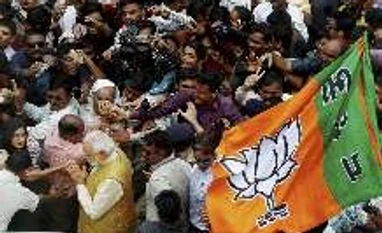
But, change, real change it seems is finally in the air. Indian democracy has reclaimed 272 with an almost pan-India judgment in favor of Modi's presidential style campaign, given the inroads he's also managed to make in Assam and south of the Vindhyas.
BJP's detractors may want to wince at TV studio hyperbole like 'tsunami' or 'saffron surge' being used to describe Modi's victory. But the indisputable fact remains that this election, particularly in the context of the coalition dharma of the last 3 decades, has been a landmark whichever way you look at it. The numbers the BJP has got are extraordinary in face of the seemingly inexorable domination of federal superpowers over the past few years as well as a popular swell of support for newer adversaries like the AAP.
Go back for a bit to compare what happened today with the two other wave elections in India's history, and the feat Modi has managed seems all the more creditable, no matter that BJP's tally of 285 may not have broken previous records. The landslide in 1984 gave Rajiv 404. In 1977 the Janata Alliance managed 345. The first was as A K Verma, a professor of Political Science at Christ Church College called it, a 'negative' wave in the aftermath of the emergency. The second a 'sympathy' wave.
But none depicted the extent of the paradigm shift being witnessed in Indian politics as the 2014 wave does. The unequivocal mandate of the people is today equally for a decisive, stable government, and a leader who instills a sense of hope and aspiration in them, as it is against a corrupt, ineffective leadership and the politics of caste and reservations prevalent in the Hindi heartland.
And so from that standpoint, 2014 could well be christened a 'governance wave' that marked the evolution of India's politics and the maturing of its democracy, toppling even concerns about the checkered, communal history of India's PM in waiting. For development and progress, India was willing to forgive and forget it seems, disturbing as this might still be for lakhs who didn't vote for Modi, particularly from the minority community.
The Congress meanwhile has only grudgingly accepted defeat, and without much grace. But their decimation is complete. Even the worst prediction - according to the News 24 - Chanakya exit poll was for 70 seats to the UPA. At 61, it is their worst performance ever, leaving India's GOP and its coaliton partners atrophied and shrunk. And as if to add salt to wound, even heavyweights like Milind Deora and Priya Dutt have been shunted out of their seats with India's bahu 'Tulsi' or Smriti Irani keeping the party's scion Rahul Gandhi on tenterhooks all morning, even though he will eventually keep Amethi.
India hath now spoken, and Modi's real test has begun. There is much he can achieve from the mandate he's been given. But new India's expectations and aspirations are higher than ever as this election has shown, and he has much work to get cracking on, if they are to be met.

 "A wave of all waves hits India")


 Connect with us on WhatsApp