The Congress party on Wednesday promised it would continue its rights-based entitlement regime for the social sector, if voted back to power, and extend it to health, shelter and pensions for the poor and the disabled. The party also pledged to support growth by ensuring an investment of $1-trillion in the infrastructure sector over the next decade, 10 per cent growth in the manufacturing sector and a new job-creation agenda within 100 days of forming the government.
Unveiling its manifesto for the 2014 elections, the party, however, made it clear it would always stand with the underdog.
Congress President Sonia Gandhi said: “While the manifesto contains new initiatives like the right to health and right to shelter for below-poverty-line (BPL) families, we want to put in place a plan for social security for the poor.”
Party vice-president Rahul Gandhi said: “The 2014 elections are about giving constitutional guarantees to those struggling to eke out a living. Their claim to India is as strong as anyone else’s”.
The manifesto committed the party to training 100 million young people and giving them employment opportunities in five years. All low-income families will get health, pension and housing as a matter of right, the manifesto outlines, adding the party will unveil a new jobs agenda within 100 days of coming to power. All Indians will have a bank account in five years and there will be 100 per cent access to electricity in urban areas and 90 per cent in rural areas, it promises.
The party made no secret of the fact that the manifesto and its promises were an outcome of Rahul Gandhi’s intervention. A short six-minute film shown before the release of the document showed him — and only him — interacting with a variety of people while the drafting exercise was going on. Most suggestions were incorporated in the manifesto.
To a question on why the Congress was not naming a prime ministerial candidate, Sonia Gandhi said elected Congress MPs would make that choice.
She ignored a reference to the release of the party’s manifesto in 2009, when, on being asked about the PM candidate, she had half-covered the picture on the manifesto cover in a way that only Manhohan Singh was visible.
The manifesto has some innovative governance-related ideas, too. It promises pushing for appointment of a special envoy on black money, besides establishing through a Bill an environmental regulator, described as a professional agency to conduct rigorous and time-bound environmental appraisals and recommend clearances.
The party is committed to offering tax incentives to promote domestic manufacture of information technology hardware, the document says.
Also, a special-purpose vehicle (SPV) has been promised to be set up for “fair, transparent, equitable and time-bound development of natural resources”. This is seen as a belated response to various controversies — from the alleged irregularities in 2G spectrum allocation to coal and gas scams. The manifesto says the SPV “will be responsible for judicious allocation on the basis of usage, and not arbitrarily, while striking a balance between present requirement and future demand”.
The party said it would set up a regulatory reform task force to review all regulatory processes of central government ministries to facilitate the ease of doing business in India. “We will put out a clear policy on tax treatment of foreign firms and merger & acquisition (M&A) guidelines, while ensuring that taxes are paid by multinational/foreign entities in the jurisdiction in which profits are earned,” the manifesto reads.
Buoyed by the success of the Cabinet Committee on Investment, the party also favours the creation of a National Investment Facilitation Authority, headed by the prime minister and with a full-time secretariat to identify delayed projects and facilitate rapid clearance. This job is currently thought to be done by the Cabinet secretary.
On subsidies, though the party said it favoured limiting subsidies only to the “absolutely deserving” and introducing “sensible user charges” for better quality of subsidies, the manifesto did not say whether food, fertiliser and oil subsidies would be removed (and, if yes, by when). In fact, it commits itself to providing pulses and edible oils under the Food Security Act, along with rice, wheat and coarse grain. The party also promises a clear road map for dealing with problems faced by banks in relation with rising non-performing assets, recapitalisation, succession planning and operational autonomy.
PROMISES GALORE Highlights of the Congress manifesto - Expanding rights-based programme: Offering right to housing and right to health care
- Agriculture: Committed to higher support prices for farmers
Infra & growth - Independent regulator for natural resources
- 100% electricity access in urban areas, 94% in rural
- Taking real GDP growth rate to over 8% within 3 years
- Set up a national investment facilitation panel under PM
- Investing $1 trn in the infra sector over the next decade
- Achieving 10% growth in the manufacturing sector
Job creation & growth - Unveiling a new job creation agenda
- Pushing flexible labour laws
- Creating consensus on private sector reservations
Fiscal and tax policies - Reducing fiscal deficit to 3% of GDP by FY17
- Implementing GST and DTC within a year
- Giving subsidies only where absolutely necessary
- Abolishing all export taxes
- Ensuring risk of retroactive taxes is avoided
- Ensuring foreign firms pay taxes where they earn profits
Price stability & financial reforms - RBI must balance price stability & growth concerns
- Immediately implementing all recommendations of the Financial Sector Legislative Reforms Committee

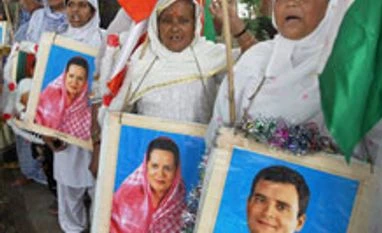 "Congress manifesto offers growth but tilts towards equity")


 Connect with us on WhatsApp